


KEY TAKEAWAYS
- In an experiment with 60 people, those told to watch a clock while trying to sleep reported more worry and took longer to fall asleep. It held for good sleepers as well as poor ones.
- In a second experiment with 38 people, clock-watchers not only took longer to get to sleep — they also overestimated how long it had taken by more than the control group did.
- Nearly 4,900 patients at a sleep clinic were assessed for time-monitoring behaviour, which was linked to worse symptoms and greater use of sleep aids.
- The man who invented the “get up after about twenty minutes” rule left the timing vague on purpose, and said in a footnote that being specific would have caused clock-watching and made things worse.
You don’t need to look. You already have a rough idea, and the rough idea is bad enough.
But your head turns anyway, and there it is. 3:14.
And you’re not reading a number. You’re doing sums. Three hours and sixteen minutes until the alarm. If I drop off in the next twenty minutes that’s still just under three. Assuming I do drop off, which last Thursday I didn’t, and that day was a write-off.
Two minutes ago you were drowsy. Now you’re running a small hostile spreadsheet in the dark.
Of everything you can change about the middle of the night, this is the cheapest. It costs nothing, takes five seconds, and there’s a surprising amount of research behind it.
What happens when researchers make people watch the clock
In 2007, Nicole Tang, Anne Schmidt and Allison Harvey published a paper in the Journal of Behavior Therapy and Experimental Psychiatry with a title that gives away the conclusion: “Sleeping with the Enemy.”
They ran two experiments.
In the first, they took 30 good sleepers and 30 poor ones, and told some of each group to watch a clock while trying to fall asleep and the others not to. They measured worry by asking, and sleep both by self-report and by actigraphy, a movement-based way of estimating when someone drifts off.
The clock-watchers reported more worry before sleep and took longer to fall asleep.
The part worth pausing on: it held for the good sleepers too. This isn’t a quirk of people who already struggle at night. Give anyone a clock to watch and it becomes harder to drop off.
The second experiment, and the strange bit
The second study took 38 people diagnosed with insomnia. After one baseline night, some were asked to monitor a clock as they tried to sleep and others to monitor a digit display that showed numbers but didn’t tell the time.
That’s a neat design, because both groups are doing the same fiddly task of staring at numbers in the dark. The only real difference is meaning.
The clock group rated the task as more worrying and more disruptive. They reported more worry before sleep and a longer time to fall asleep than on their baseline night. The display group had less worry.
Then the odd result. Compared with the display group, the clock-watchers overestimated how long it had taken them to get to sleep.
So the clock didn’t simply make the night worse. It also made the night seem worse than it was. You wake in the morning convinced you lay awake for two hours, and part of that conviction was manufactured by the thing you kept checking to find out.
The researchers’ reading was that clock-watching feeds worry before sleep, and worry distorts your sense of how long you were awake.
It’s not a small habit
If this sounds like a minor thing to write an article about, there’s a scale to it.
A study drawing on a sleep clinic sample of nearly 4,900 patients looked at what the researchers call time-monitoring behaviour. It was associated with worse symptoms and with greater use of sleep aids.
That’s an observational finding, so it can’t tell you which came first. People sleeping badly have more reason to check the time, and checking the time may well make it worse — probably both, looping round. But it does tell you the habit is common enough and connected enough to be worth taking seriously.
The footnote in the original 20-minute rule
Here’s the part that almost nobody knows, and it’s the best argument in favour of turning the clock around.
You’ve probably met the rule: if you’re awake for around twenty minutes, get up, go somewhere else, and come back when you’re sleepy. It comes from a short paper by Richard Bootzin in 1972, and half a century later it’s still the standard advice.
Bootzin wrote that instruction vaguely on purpose.
In a footnote to the original paper, he acknowledged that the instruction was imprecise, and explained why he’d left it that way: being more specific would have produced clock-watching, and that would make the problem worse.
Fifty years of sleep articles have since turned his deliberately fuzzy guidance into a hard number. Which is precisely the thing he was trying to prevent.
So if you’ve ever lain there wondering whether it’s been twenty minutes yet — checking, doing the arithmetic, checking again — you were following the letter of the rule while breaking the thing it was designed to protect.
Use the version he meant
The trigger was never a number on a display. It’s a feeling, and you know it when it arrives: you’re properly awake, and you’re starting to get annoyed about being awake.
That’s the cue. Not twenty minutes. And it’s the only version of the rule you can follow without a clock, which is the whole point.
What to do instead
The fix is genuinely just: don’t look.
That sounds too simple to work, and there’s a reason it’s harder than it sounds. A separate study found that people with insomnia take longer to pull their attention away from clock-related cues than other people do. If you’ve built the habit, the clock isn’t a neutral object in the room any more. It pulls.
Which means willpower at 3 a.m. isn’t the plan. Removing the option is.
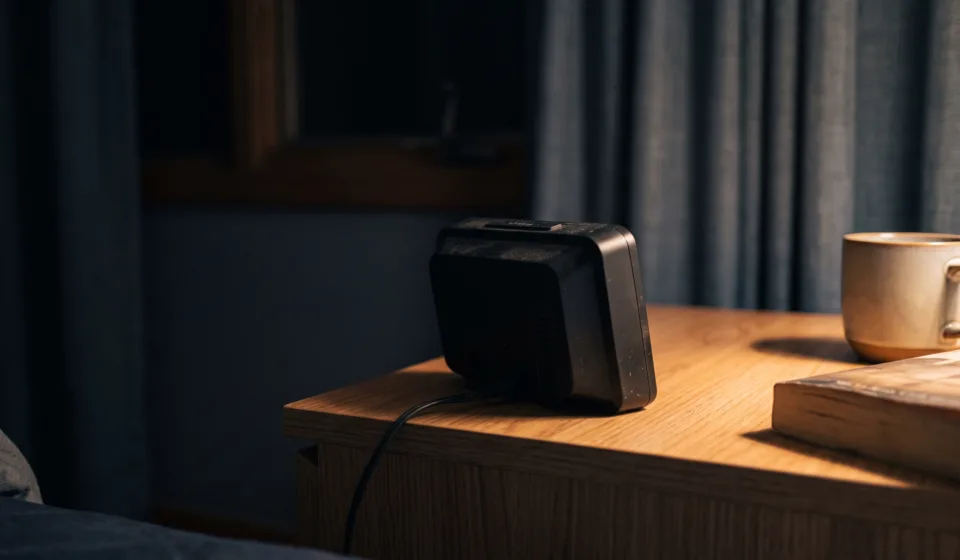
Turn the clock to face the wall. Not off, not dimmed — turned around, so looking at it requires getting up. If it’s your phone, put it somewhere you’d have to stand to reach, and use a real alarm clock, turned away, instead.
The one objection people raise is the alarm. You still need to be woken. But you don’t need to know what time it is at 3 a.m. — you need a noise to happen at 6:30. Those are different jobs, and only one of them requires a visible display.
Give it about a week. The first couple of nights you’ll reach for it out of habit and find nothing there, which is mildly irritating. After that most people stop reaching.
What you get back
You won’t sleep better the first night. This isn’t that kind of change.
What goes away is the arithmetic. Lying awake without knowing the time is a fairly dull experience. Lying awake while calculating exactly how bad tomorrow will be is something else, and the second one is what keeps people up.
You’ll also find your mornings recalibrate. Without a running tally of the night’s failures, you’re less likely to wake up already certain you slept badly — which, going by the research, you may not have done as badly as you thought.
References
- Tang N.K.Y., Schmidt D.A., Harvey A.G. “Sleeping with the enemy: clock monitoring in the maintenance of insomnia.” Journal of Behavior Therapy and Experimental Psychiatry, 2007;38(1):40–55. doi:10.1016/j.jbtep.2005.07.004
- Dawson S. et al. “Use of Sleep Aids in Insomnia: The Role of Time Monitoring Behavior.” Primary Care Companion for CNS Disorders. psychiatrist.com/pcc/use-of-sleep-aids-in-insomnia-the-role-of-time-monitoring-behavior
- Bootzin R.R. “Stimulus Control Treatment for Insomnia.” Proceedings, 80th Annual Convention of the American Psychological Association, 1972.
- Woods H. et al. “The clock as a focus of selective attention in those with primary insomnia: An experimental study using a modified Posner paradigm.”

Diana Woods researches and writes about sleep, environment and everyday habit. She has no clinical training, and that shapes what this site does: instead of explaining what might be wrong with you, she reads the behavioural and environmental research and writes about the parts you can act on — the light in the hallway, the fifteen feet to the bathroom, what the morning does to the night that follows.
Every article here cites its sources, and she tries to include the parts researchers themselves flag as uncertain. Studies disagree, sample sizes are small, and correlation gets reported as cause more often than it should. Saying so is part of the job.