

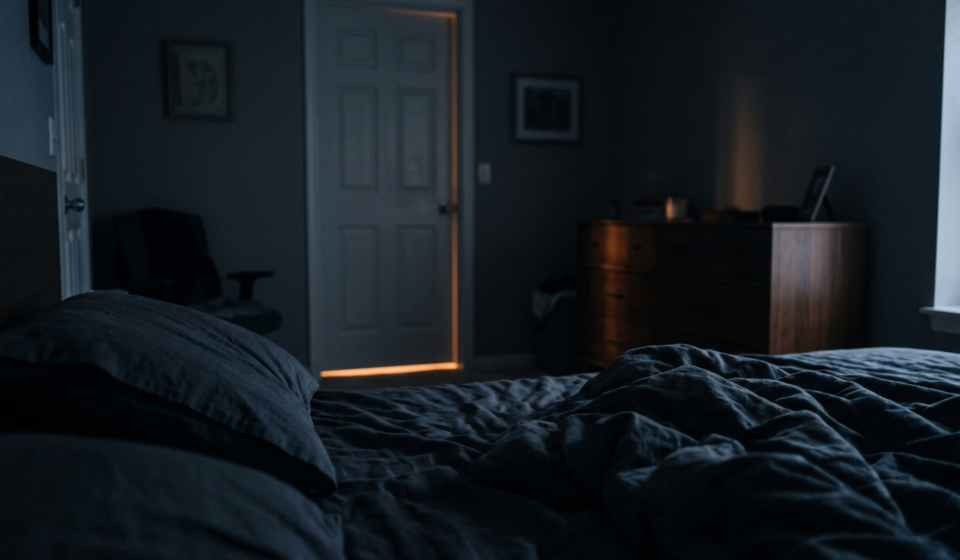
Where to Put Your Bed in the Bedroom: What the Research Says About Door, Window and Wall

Key Takeaways
- The rules about where a bed should sit (solid wall behind the head, a clear view of the door) usually don’t come with a study that tests them. I didn’t find one.
- A German study found most people, given a paper floor plan, place the bed to see the door. It measured preferences, not sleep.
- A popular survey linking layouts to better sleep is commercial and correlational, and the account I read doesn’t say how sleep was measured.
- The best-supported finding is about noise: bedrooms facing away from the street show up as the strongest modifier in a Swiss study of 5,592 people. Where the bed sits inside the room wasn’t tested.
At 3:10 a.m. you stand up in the dark and your shin meets the corner of a dresser you’ve owned for eleven years. It’s not the dresser’s fault. It’s been in the same place the whole time. The real culprit is the bed, which went wherever it went on move-in day, decided by whoever was holding the other end of the frame, and nobody has questioned it since.
Where the bed sits gets decided once, fast, usually by which wall it fits. Then you live with the answer for a decade. And if you go looking for rules, you’ll find plenty: solid wall behind the head, a clear view of the door, never with your feet pointing out of it.
Those rules usually come with a name, “command position” in feng shui, and a story about safety or flow. I went looking for the research behind them, and I didn’t find a study that tests them directly. The short version is that there’s less than you’d think, and one of the better-supported findings is about noise, not about where the headboard goes. Here’s what’s been studied, what’s a commercial survey wearing a lab coat, and a test for your own room that almost nobody writes about.
Where the rules come from
The study people point to is a German one, published in Evolutionary Psychology in 2010 by Matthias Spörrle and Jennifer Stich [1]. As described in a Pacific Standard write-up, 138 volunteers each got a floor plan of a bedroom, with the door opening left or right and a window or no window, and arranged paper cutouts of a bed, a table and a chair however they liked. Most put the bed where they could see the door from the pillow (83 percent in the account I read), and about 70 percent pushed it against the wall opposite the door.
The authors read that as an echo of ancestral safety needs: spot who’s coming in, stay hidden, have time to react. They also admit a plainer explanation might do just as well, which is drafts from the entrance.
Now the fine print. Nobody here slept anywhere. Participants arranged symbols in hypothetical rooms, not their own, and the study measured preferences, not sleep. I’ve read a magazine’s account of it, not the paper, and the write-up doesn’t report what happened with the window. So what you can take from it is that many people choose to face the door. Whether facing the door helps anyone sleep is a separate question, and this doesn’t touch it.
Where to put your bed in the bedroom: what the survey data says
The other thing you’ll meet is a survey. Sleep Junkie, a sleep review website, asked about 1,000 Americans about their bedroom setups and how well they slept, as reported by Fit&Well [2]. The reported result: people whose bed sat against a wall with the door to the side did best, and people whose bed faced the door and ran parallel to the window did worst. The same piece says wall color mattered too, which should tell you something about how far to trust it.
I wouldn’t. This is a commercial survey, not peer-reviewed research. The account I read doesn’t explain how sleep quality was measured or how the groups were compared, and it’s correlational by design. People pick layouts for reasons that may have nothing to do with the bed: room size, what else is in the room, who else is in the bed. So a pattern could come from any of those. It’s a headline, not a finding.
The finding with actual data in it
The best-supported effects I found involve the window, not the headboard. And they’re about which side of the building the bedroom is on.
In 2019, Mark Brink and colleagues published results from SiRENE, a Swiss study that sent questionnaires to 5,592 people and calculated night-time noise at several points on the outside of each home [3]. People who were highly sleep disturbed were more likely at higher noise levels, as you’d expect. The more interesting part: bedroom orientation was the strongest factor that changed the picture. Bedrooms facing away from the nearest street showed an effect equivalent to nearly 20 decibels of noise. Window position, as the study defined it, didn’t change the associations.
A Swedish team including Susanne Bartels asked working women about it in a cross-sectional study published in 2021 [4]. Among 1,764 women who answered the window question, poor sleep was more common when the bedroom faced a medium- or high-traffic street, around a quarter of them. But in the fully adjusted models that fell to a non-significant trend, and the authors list their own limits: it’s cross-sectional, so cause can’t be settled, it covers only women, and the response rates were modest.
Two cautions. Both studies rest on questionnaires, and neither measured where inside the bedroom the bed stood. They’re about which wall of the house the bedroom is on. So I can tell you that, if you have a choice between a street-facing bedroom and a back one, there’s evidence the quiet side matters. I can’t tell you how far from the window the bed should sit. I didn’t find anyone who tested that.
The test nobody writes about: the night walk
Everything above is about sleeping. None of it covers what happens when you’re up, which is where most of this blog lives. The bed’s position decides your route: how many steps to the door, how many turns before the bathroom, what’s at shin height along the way. I found no study of that, so what follows is common sense, not research.
Try this once. Turn the lights off, or leave on only what you’d normally use at night, and walk from your pillow to the door and then to the bathroom, slowly, as if half asleep. Count the turns, not the steps. Each turn is a place where you steer by memory. Notice what you touch: the dresser corner, the open door, the cord, the edge of the rug.
Walk it both ways. Coming back from the bathroom you’re even less awake, and the route that felt fine going out can have a different problem when you’re aiming for the bed. It’s a guess about how half-asleep people move, not a finding, but it costs one extra trip.
Then move one thing, not everything. It might be the dresser, the rug or a chair. It might be which side of the bed you sleep on. If two of you share the bed, the person who gets up more often probably belongs on the door side. That isn’t a finding. It’s the shortest route.
Give the change two weeks and jot one line each morning, nothing fancy. Treat the first few nights as unreliable, because a new arrangement feels strange before it feels better or worse. And if you can’t tell the difference after two weeks, you’ve learned that this wasn’t your problem.
One more thing the research won’t tell you: some rooms only have one wall that works. If yours does, the answer is to make the route safe, not to chase a layout from an article.
Back to the dresser corner
The rules about where a bed should sit are older than the evidence for them. The best data points to which side of the house the bedroom is on, and the rest comes down to what suits you and the people who share the room. So the useful question at 3:10 a.m. isn’t “is my bed in the right place?” It’s “what did my shin just find?”
Contagem: 1.292 palavras (conta o H1 e os subtítulos; exclui Key Takeaways, referências e bio).
References
- Spörrle M, Stich J. Evol Psychol. 2010. Title, volume and pages not verified; read through the Pacific Standard write-up (psmag.com). Accessed Oct 16, 2026.
- Fit&Well. Article reporting a Sleep Junkie survey on bed position and wall color. fitandwell.com/news/research-reveals-the-best-bed-position-and-wall-color-for-better-sleep. Accessed Oct 16, 2026.
- Brink M, Schäffer B, Vienneau D, et al. Self-reported sleep disturbance from road, rail and aircraft noise: exposure-response relationships and effect modifiers in the SiRENE study. Int J Environ Res Public Health. 2019;16(21):4186.
- Bartels S, Ögren M, Kim J-L, et al. The impact of nocturnal road traffic noise, bedroom window orientation, and work-related stress on subjective sleep quality: results of a cross-sectional study among working women. Int Arch Occup Environ Health. 2021;94:1523-1536.

Diana Woods researches and writes about sleep, environment and everyday habit. She has no clinical training, and that shapes what this site does: instead of explaining what might be wrong with you, she reads the behavioural and environmental research and writes about the parts you can act on — the light in the hallway, the fifteen feet to the bathroom, what the morning does to the night that follows.
Every article here cites its sources, and she tries to include the parts researchers themselves flag as uncertain. Studies disagree, sample sizes are small, and correlation gets reported as cause more often than it should. Saying so is part of the job.