
KEY TAKEAWAYS
- Most bedroom checklists are done standing up with the lights on. A bedroom audit works better lying in your usual position with the lights off, because the pillow sees a different room than the doorway does.
- In a laboratory study, room light shifted sleep toward lighter stages even though the volunteers didn’t rate their sleep as worse. Not noticing a light isn’t proof it isn’t there.
- A review of heat and cold studies found heat reliably increased time awake, while cold mostly did not, as long as bedding was adequate. Layers you can adjust without sitting up may matter more than the thermostat.
- In one observational field study, noise at the start and end of the night tracked sleep quality most closely. On bed position, the evidence is thin enough that treating it as a route question is the safer approach.
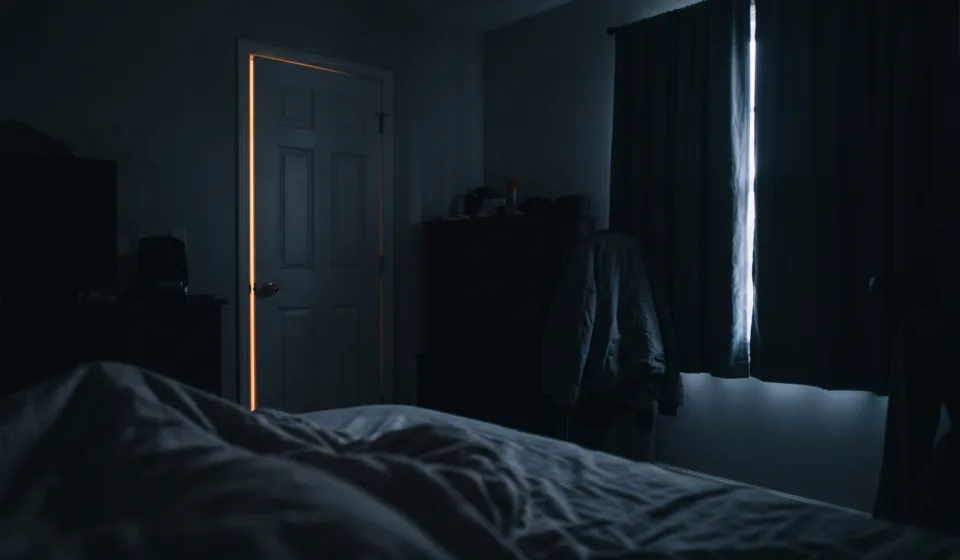
At 3:12 a.m. you finally see the room. Not the one you tidied this afternoon, the other one: a green dot on the power strip, a pale stripe under the door, a thin bright seam where the curtains don’t quite meet. You’ve slept here for years. You’ve never looked at it from this angle.
The standard bedroom checklist hasn’t either. It was written from the doorway.
This is a walkthrough you do once, in about eleven minutes, lights off and lying on your usual side. Four passes: what you can see, what you can hear, what the covers are doing, and what the first few steps toward the door look like in the dark. Nothing to buy, no number to hit. You finish with a short list in your own words, ordered by what bothers you most.
A bedroom audit starts where the usual checklist stops
Search for a sleep environment checklist and nearly every page returns the same three pillars: temperature, light, noise. The printable versions, like the one from the Sleep Foundation [6], ask whether the room is cool, quiet and dark and leave a box to tick. That’s reasonable. It also stops at the thermostat.
The problem is the vantage point. Standing in the middle of the room with the lamp on, you’re a visitor, with your eyes well above the pillow and adjusted to the very light you’re trying to judge. Lying down in the dark, you’re the instrument: you’re the one the light reaches, the blanket touches, the sound crosses the room to find.
One honest note on the method: nobody has tested this audit as a whole, and “eleven minutes” is just roughly how long the four passes take. What it borrows from the research is narrower, namely what each piece of the room has been shown to do to sleep, and how far those findings reach.
Minutes one to three: the lights you only see once your eyes adjust
Turn off the last lamp. Lie the way you actually sleep, and wait a few minutes before you start looking.
Then look from the pillow, not around the room: standby lights, a charger glow, the strip under the door, the seam at the curtain, whatever outdoor light climbs the ceiling. Count them on your fingers. Leave the phone where it is, because a lit screen would wreck the whole pass.
A 2022 laboratory experiment in PNAS is the reason to bother [1]. Twenty young adults were split into two groups: one slept two nights in dim light, the other slept one night in dim light and one under overhead room lighting. On the room-light night, sleep shifted. Proportionally more of it was lighter sleep, and less of it was deep sleep and dream sleep. Their own ratings of how well they’d slept did not change.
That last detail is the useful one, and the easy one to miss. Not noticing a light and not being affected by it are two different claims, and the volunteers could only vouch for the first.
The limits are real. Twenty people, all young, ten per group, one night, with overhead lighting rather than a power-strip LED. The study shows a direction, not what your green dot does. Count the lights anyway. Fix nothing yet.
Minutes four to six: listening for the hour, not the volume
Stay where you are and listen. Sort what you hear into two piles: steady (a fan, the refrigerator through the wall, far-off road hum) and sudden (a door, a pipe, footsteps upstairs, a car). Then, for each one, ask what hour it usually shows up.
The hour turns out to matter. A Swiss field study followed 105 volunteers for a week, with movement sensors on their wrists and noise measured at their bedroom windows [2]. Noise at the beginning and the end of the night was the most closely tied to how well they slept. The authors concluded that when a noise arrives counts, and that the night’s average level doesn’t capture everything.
It was observational, which means people in loud places differ from people in quiet ones in a dozen other ways. It can’t prove the noise was the cause.
A second finding pulls the other direction. A laboratory study of aircraft, road and rail noise [3] was the subject of a commentary in the journal Sleep [4], which noted that more than 90 percent of the awakenings the noise triggered took the place of awakenings that would have happened spontaneously anyway. The commentary read that as sleep keeping its overall shape despite the noise. It also warned that laboratory participants have the chance to adapt over the nights of a study, and that research on noise and sleep doesn’t always point in one direction.
Put the two together and the lesson is modest: not every sound you hear at night is the reason you’re awake. The practical use is a note, not a purchase. Next time you wake, ask whether the sound came before you woke or after. A 5 a.m. delivery truck and a television through the wall at 11 are different problems.
Minutes seven to nine: it’s often the covers, not the room
Feel what’s on you. How many layers? Could you shed one, or pull one up, with one arm and without sitting up? If someone is beside you, whose side runs warm?
Most advice says cool. A 2012 review of how the thermal environment affects sleep found something lopsided [5]. In real-life conditions, with bedding and clothing, heat exposure increased time awake and cut deep sleep and dream sleep, and humid heat made it worse. Cold exposure, by contrast, did not change the sleep stages; what it asked for was enough bedding and clothing.
Read that way, the goal is less “a cold room” than “not overheating, with layers that change in one move.” I can’t give you a single temperature, and the review itself says the results depend on what people wear and sleep under.
Keep the limits in view. The review is built largely on its authors’ own experiments, and it’s now over a decade old. A review isn’t a measurement of your bed, either.
With two people in the bed, the layers question is bigger than the thermostat question, because one thermostat and two bodies is where the argument starts.
Minutes ten and eleven: the walk nobody audits
Now get up. Eyes half open, take the route you’d take at 3 a.m.: bed to door, door to bathroom. What’s on the floor? Where does the hall or bathroom light land on the way? How many steps until you’re standing in light you’d rather not be in?
Where the bed sits is the one part of this where the advice is most confident and the evidence thinnest. What circulates is a blend of feng shui tradition, designers’ opinion and surveys. The only layout data I found came from a self-report survey on a sleep-product site, which itself notes the limits of self-reporting, and I found no controlled study of bed position and sleep.
So treat position as a route question rather than a rule. Where does the door’s light fall when it opens? Where does a draft come from? How far is the first step, and what’s on it?
Two pillows, two different rooms
If you share the bed, repeat the first pass from the other side, or ask them to. A light that sits behind your head is invisible to you and square in your partner’s eyeline. The window side hears the street; the wall side hears the neighbors. Nobody needs a study for this one. It’s geometry.
It also changes who gets to be the judge. The person who doesn’t mind the green dot isn’t wrong, just lying somewhere else.
What to do with the list
You’ll have a short list now. Resist the weekend overhaul. Change the cheapest item first, leave the rest alone for a few nights, and see whether anything shifts, since changing five things at once tells you nothing about which one counted. That’s ordinary common sense, not a protocol anyone has tested. And it’s possible to finish the audit and find the room is fine, which is also a result.
An audit gives you a list, not an order. The order depends on something you can’t settle from the pillow: which of these things is actually waking you, and which is only the one you’ve learned to notice at 3 a.m.? The only way to find out is to catch the next waking in the act. What was the first thing you noticed?
References
- Mason IC, Grimaldi D, Reid KJ, Warlick CD, Malkani RG, Abbott SM, Zee PC. Light exposure during sleep impairs cardiometabolic function. Proc Natl Acad Sci U S A. 2022;119(12):e2113290119. doi:10.1073/pnas.2113290119
- Röösli M, Brink M, Rudzik F, Cajochen C, Ragettli MS, Flückiger B, Pieren R, Vienneau D, Wunderli JM. Associations of various nighttime noise exposure indicators with objective sleep efficiency and self-reported sleep quality: a field study. Int J Environ Res Public Health. 2019;16(20):3790. doi:10.3390/ijerph16203790
- Basner M, Müller U, Elmenhorst EM. Single and combined effects of air, road, and rail traffic noise on sleep and recuperation. Sleep. 2011;34(1):11-23. doi:10.1093/sleep/34.1.11
- Hume KI. Noise pollution: a ubiquitous unrecognized disruptor of sleep? Sleep. 2011;34(1):7-8. doi:10.1093/sleep/34.1.7
- Okamoto-Mizuno K, Mizuno K. Effects of thermal environment on sleep and circadian rhythm. J Physiol Anthropol. 2012;31:14. doi:10.1186/1880-6805-31-14
- Sleep Foundation. Bedroom Environment Checklist (printable PDF), 2021. sleepfoundation.org

Diana Woods researches and writes about sleep, environment and everyday habit. She has no clinical training, and that shapes what this site does: instead of explaining what might be wrong with you, she reads the behavioural and environmental research and writes about the parts you can act on — the light in the hallway, the fifteen feet to the bathroom, what the morning does to the night that follows.
Every article here cites its sources, and she tries to include the parts researchers themselves flag as uncertain. Studies disagree, sample sizes are small, and correlation gets reported as cause more often than it should. Saying so is part of the job.