

Key Takeaways
- At night, where a light sits matters as much as how bright it is. A light at floor level lands on the path, not in your eyes.
- Red isn’t a free pass. In two small lab studies, red light raised measures of alertness in people awake at night. What it avoided, in the one study that tested it, was a drop in the body’s nighttime signal.
- The two settings that decide whether a motion light helps or hurts are the delay (how long it stays on) and the sensitivity (what sets it off).
- Nobody has tested motion lights at floor level against other placements for sleep. What follows is the studied part and the reasoned part, kept apart.
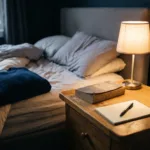
You’re awake, and you know it, because the light in the hallway just came on. It isn’t a bad light. It’s a motion light, mounted at head height, and it did exactly what it was built to do, which is to wake up the whole corridor as you walked into it.
By the time you reach the other end, you’re fully awake, and the only thing that’s changed since you got out of bed is the light. This article is about the version that doesn’t do that: a light low on the wall that shows the floor and leaves the rest of the dark alone.
Why height does most of the work
Start with the part that isn’t a study but is hard to argue with. A light mounted at eye level throws light into your eyes. A light mounted near the floor throws it onto the surface you’re walking on. The same fixture at two heights is two different experiences: one tells your eyes it’s morning, the other lets them keep the dark they have.
I’ll be direct about what this is. I could not find research that compares motion lights at floor level against other heights for sleep. It’s reasoning from how light reaches the eye, and it matches what most people report.
What does have research is the next part.
The color question has a twist
The standard advice is red or amber, on the logic that long wavelengths are gentler at night. That advice gets support, but not the kind people assume.
In a 2016 study from Mariana Figueiro and colleagues, 17 people did a three-week within-subject laboratory study during nighttime hours. They were exposed to red light (630 nm), white light (2,568 K) and dim light as the control. Compared with dim light, reaction times were significantly faster after both red and white light, and brain-wave measures of alertness rose after red light. The body’s nighttime signal was significantly suppressed by white light only.
Read that carefully. Red light was alerting. What it avoided was the suppression of the body’s signal for night. It doesn’t make you sleepy. It makes you alert without the second effect.
A separate paper in BMC Neuroscience (2009) found something similar with a smaller group: 14 people, 45 minutes of exposure, blue or red light at two intensities. Both colors reduced a brain-wave marker of relaxation, regardless of color or brightness. Only the strongest blue condition lowered the nighttime signal, by 18 percent. Performance and sleepiness ratings weren’t strongly affected.
Both studies are small. Both were in controlled labs with people who were awake for the experiment. And both exposed people to light at much steadier levels than a motion light delivers in a few seconds. But they point the same way: color changes what the light does to your biology, and it doesn’t make the light inert.
So the practical rule is lower and dimmer first, red or amber second. A very dim white light and a very dim amber light are closer to each other than a bright amber and a dim amber.
The two settings that matter more than the bulb
Delay. Most motion lights stay on for a set time after the last movement. Too short and the light shuts off while you’re mid-path, which leaves you in a darkness that feels darker than before. Too long and it keeps lighting a hallway you’ve left. You want the shortest delay that still covers the walk, and you find it by walking it.
Sensitivity. The setting people ignore. If a light triggers when anyone moves in the next room, or when a pet crosses the floor, it will turn on for events that have nothing to do with you. If it triggers only when you’re directly in front of it, it may turn on after you’ve already taken your first steps. Aim the sensor at the path, not the room, and test it from the bed.
Neither has research behind it. Both are the difference between a light that helps and a light that argues with you.
What to look for, in order
A light that you can aim downward, or that is shielded so the source isn’t visible from the bed. A warm or amber setting, and the ability to dim it. A sensor you can adjust, or at least one that covers a narrow arc. Battery or plug-in, whichever means you won’t have to take it down to change it.
Leave off the list the features that add their own light: indicator LEDs, status lights, small screens. A light that sits there glowing when nothing is happening isn’t a night light. It’s a standing exception to the dark.
Where to put it
Low on the wall, pointed at the floor, near the start of the path rather than the middle. If your path has two turns, one light at the first turn is usually better than two lights along the way, because the first one shows you the direction and the dark does the rest.
Not facing the bed. Not above the door. And not in the line of sight from the pillow, which is the one thing worth checking from the bed: lie down, look around, and make sure you can’t see the source.
A fair limit on all of this
A motion light is a convenience, not a treatment, and I’m not making a claim that it helps anyone sleep. The evidence is that light of the wrong kind, in the wrong place, makes being awake more awake. The inverse, that the right light makes you sleep, isn’t something these studies show.
What they allow is a smaller and more honest claim: if you’re going to be up, a low, dim, well-placed light does the least harm.
The check you can do tonight
Walk the path with the lights off, once, at the hour you’d actually use it. Notice where your eyes go. If they go to a light source, move it. If they go to the floor, you’re done.
References
- Figueiro, M. G., Sahin, L., Wood, B., & Plitnick, B. (2016). Light at night and measures of alertness and performance. Biological Research for Nursing.
- “Preliminary evidence that both blue and red light can induce alertness at night.” BMC Neuroscience, 10:105 (2009).
- Sleep Foundation. What to Do When You Can’t Sleep: 8 Expert-Backed Tips.

Diana Woods researches and writes about sleep, environment and everyday habit. She has no clinical training, and that shapes what this site does: instead of explaining what might be wrong with you, she reads the behavioural and environmental research and writes about the parts you can act on — the light in the hallway, the fifteen feet to the bathroom, what the morning does to the night that follows.
Every article here cites its sources, and she tries to include the parts researchers themselves flag as uncertain. Studies disagree, sample sizes are small, and correlation gets reported as cause more often than it should. Saying so is part of the job.