

KEY TAKEAWAYS
- Bad sleep on the first night somewhere new has a name, the first-night effect, and a 2016 Brown University study found a reason for it: one half of the brain sleeps more lightly and stays on watch.
- That watchful half reacts most to unexpected sounds, not to sound in general. A steady hum bothers it far less than a door slamming down the hall.
- The effect largely faded by the second night in the study. The first night is the one worth planning for.
- Most of the fixes happen in the ten minutes after you check in: quieting the stray lights, making the noise steady, and walking the route to the bathroom before you’re half asleep.
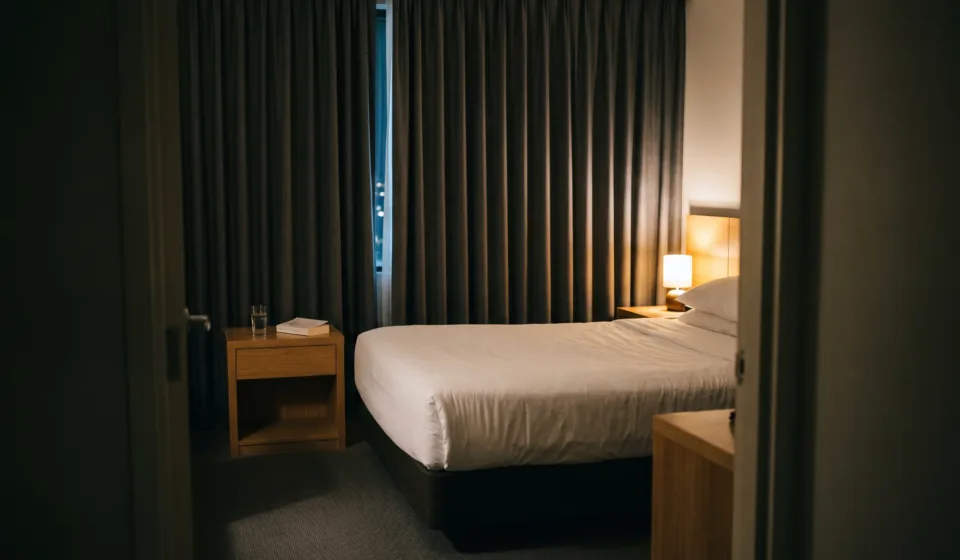
The bed is bigger than yours at home. The sheets are crisp. The room is, by any reasonable measure, nicer than your bedroom.
And you’re awake at 2:40, listening to someone’s suitcase roll past the door.
If this happens to you on almost every trip, it’s not the mattress and it’s not you being fussy. Sleep researchers have known about it for decades, and in 2016 a team at Brown University found something that helps explain what’s going on. Once you understand it, the way you set up a hotel room for the night changes quite a bit.
Half your brain is on guard duty
Researchers call it the first-night effect. People sleeping somewhere new for the first time take longer to fall asleep and sleep less deeply, even when everything about the room is fine.
The Brown team, led by Masako Tamaki and Yuka Sasaki, wanted to know why. They brought volunteers into the lab for two nights and measured the depth of sleep in each half of the brain separately.
On the first night, the two halves didn’t match. A network in the left hemisphere stayed in lighter sleep than the same network on the right. And the bigger that mismatch was, the longer the person took to fall asleep.
The researchers compared it to what dolphins and some birds do, sleeping with one half of the brain while the other stays alert enough to notice danger. The old phrase about sleeping with one eye open turns out not to be far off.
By the second night, the difference had gone. The brain had checked out the new place and decided it was safe.
The watchman listens for change, not noise
This is the detail that most travel advice misses, and it’s the one you can actually use.
During the study, the researchers played two kinds of beeps while volunteers slept: a regular, repeating tone, and an occasional odd one that broke the pattern. On the first night, the lighter-sleeping half of the brain reacted strongly to the odd beeps. Those unexpected sounds led to more awakenings, and people woke faster in response to them.
The regular beeps didn’t have that effect.
In other words, the part of your brain keeping watch isn’t bothered by sound as such. It’s paying attention to change. The ice machine clunking, a door banging down the corridor, the air conditioner kicking on after twenty minutes of silence. Those are the sounds it’s built to notice.
That’s why a hotel can feel restless even when it’s fairly quiet. A mostly silent room with occasional interruptions may be harder to sleep in than one with a constant low hum.
A fair caveat
The study was small, a group of healthy young volunteers in a laboratory. It didn’t test hotels, white-noise machines or earplugs. Turning its findings into advice means making a reasonable inference, not repeating a proven result.
Still, the inference is simple and the cost of trying it is close to nothing: make the room’s sound more even, and the watchman has less to react to.
Make the room predictable
You can do most of this in the few minutes after you drop your bags.
Steady sound
Find the thermostat or the air-conditioning panel. Many hotel units run on an automatic setting that cycles the fan on and off through the night, and each switch is exactly the sort of change the watchful half of your brain notices. If there’s a setting that keeps the fan running continuously, use it. A steady whoosh all night is gentler than silence broken every half hour.
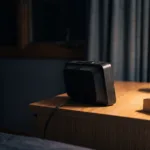
If the room is quiet but the corridor isn’t, a steady sound of your own helps for the same reason. A fan, a white-noise app playing from a phone left face down, anything that doesn’t change. Keep it low. You’re not trying to drown anything out, just to give the background a consistent shape.
When you book or check in, it’s worth asking for a room away from the elevators and the ice machine. Those are the two biggest sources of sudden noise on most hotel floors.
Stray lights
Hotel rooms are full of small lights: the TV standby dot, the glowing thermostat, the smoke detector, the alarm clock nobody set, the strip of hallway light under the door.
Individually they’re tiny. Together, in a room your brain is already treating as unfamiliar, they add to the feeling of being somewhere you can’t quite relax. Turn the clock to face the wall. Lay a hand towel over the TV’s standby light. If the curtains don’t quite meet in the middle, a trouser hanger from the wardrobe, clipped across the gap, closes it neatly. A rolled-up towel along the bottom of the door blocks the corridor light and softens some of the corridor sound too.
Walk the route before you need it
At home, you can get to the bathroom in the dark without really waking up, because your body knows the way. In a hotel room it doesn’t. Where’s the switch? Which side is the bathroom? Is that the suitcase?
Every one of those questions wakes you up a little more, and on a first night your brain is already primed to overreact.
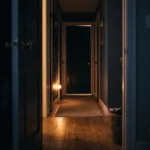
So before bed, turn everything off and walk from the bed to the bathroom and back. Move the suitcase against the wall, out of the path. Notice where the bathroom light switch is. It’s almost always a single bright overhead light, often wired to an extractor fan that roars the moment it comes on.
That combination is about the worst thing you can meet at 3 a.m. A simple alternative is to leave the bathroom light on with the door pulled almost shut, so a thin sliver of light marks the way and you never have to touch the switch. If you travel often, a small plug-in night light in your bag does the same job more gently.
Beating the first-night effect when it’s more than one night
The study found the watchful half of the brain settles down by night two. That’s useful to know for a couple of reasons.
On a short trip, it means you shouldn’t judge a hotel, or your own sleep, by the first night. A rough first night is normal, and it usually doesn’t mean the next one will go the same way.
It also suggests that familiar things might help the brain decide sooner that it’s safe. This part is my inference rather than something the study tested, but it’s the same idea behind advice travelers have given each other for years: your own pillowcase, the same book you read at home, the same few minutes of routine before lights out. Small signals that this place isn’t entirely new.
And if you wake at 3 a.m. and can’t settle, the usual rule applies even more in a hotel. Lying there getting frustrated doesn’t help. Getting up, sitting in the chair by the window with a dim light for a while, and going back when you’re sleepy usually works better than fighting it.
The ten-minute check-in routine
Before unpacking anything else, take care of the night.
Set the fan to run continuously if the unit allows it. Close the curtain gap. Turn the clock away and cover the standby lights. Put the suitcase against the wall. Walk the route to the bathroom once in the dark, and decide now how you’ll light it later.
None of this makes the room familiar. What it does is take away most of the small surprises the watchful half of your brain is waiting for, so that on the first night it has less to do.
With luck, it’ll get bored and go to sleep with the rest of you.
References
- Tamaki M., Bang J.W., Watanabe T., Sasaki Y. “Night Watch in One Brain Hemisphere during Sleep Associated with the First-Night Effect in Humans.” Current Biology, 2016;26(9):1190–1194. doi:10.1016/j.cub.2016.02.063
- Brown University. “Asleep somewhere new, one brain hemisphere keeps watch.” News release, April 21, 2016. brown.edu/news/2016-04-21/sleep

Diana Woods researches and writes about sleep, environment and everyday habit. She has no clinical training, and that shapes what this site does: instead of explaining what might be wrong with you, she reads the behavioural and environmental research and writes about the parts you can act on — the light in the hallway, the fifteen feet to the bathroom, what the morning does to the night that follows.
Every article here cites its sources, and she tries to include the parts researchers themselves flag as uncertain. Studies disagree, sample sizes are small, and correlation gets reported as cause more often than it should. Saying so is part of the job.