
KEY TAKEAWAYS
- A review in Sleep Medicine Reviews pulled together the experiments on bright screens before bed. The delays were consistently tiny, and in several studies people fell asleep faster with the bright screen than without it.
- A trial of Apple’s Night Shift found it made no measurable difference to sleep.
- The same review judged that bright screen light and general arousal both have a small-to-negligible effect — when a phone is used before your usual bedtime. Three in the morning isn’t that.
- Which shifts the question from how bright the phone is to whether what you open can start something in your head.
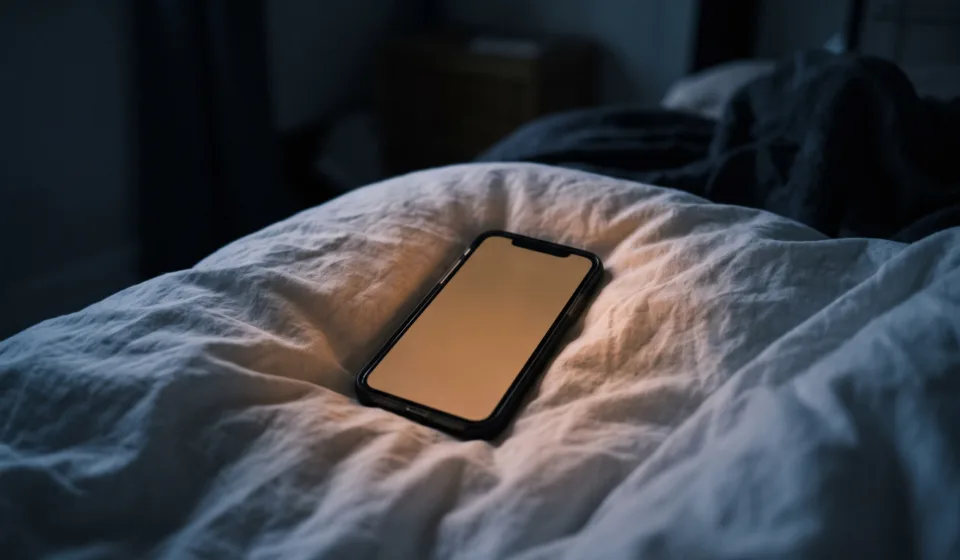
You wake at three and lie there for a while, and eventually the hand goes out for the phone.
You’ve been sensible about it. Night mode is on, brightness at the lowest notch, the screen that warm amber colour that’s meant to make this all right.
Forty minutes later you’re wider awake than when you started, having read a news story you had no use for and an email you can’t do anything about until Monday.
The amber tint worked exactly as advertised. It just wasn’t solving your problem.
The screen-light story is smaller than it sounds
You know the claim, because everyone has repeated it. Screens give off blue light, blue light interferes with the body’s sense that it’s night, so phones wreck your sleep.
The first two parts hold up. It’s the jump to the third that’s been oversold.
In 2024, a group of sleep researchers published a review in Sleep Medicine Reviews pulling together the studies that had directly tested it. What they found across those experiments was an oddly consistent pattern: bright screen use pushed sleep onset back by small amounts, over and over.
They used the word perplexing. And here’s why. In several of the studies, people in the bright screen condition fell asleep faster than the people in the control condition.
Not a little worse. Better.
When the same authors summarised the wider evidence for a general audience, drawing on 73 studies and more than 113,000 participants, the average delay from a bright, blue-light-emitting screen came out at 2.7 minutes.
Under three minutes, from the thing that’s supposed to be ruining everyone’s nights.
And the fix didn’t fix anything
If light were the mechanism, night mode should be the answer, and that’s roughly how it was sold when Apple launched Night Shift in 2016.
Researchers at Brigham Young University, with colleagues at Cincinnati Children’s Hospital Medical Center, put it to the test. Three groups: phone with Night Shift on, phone with it off, no phone at all.
The Night Shift group did no better.
One of the researchers offered a plain explanation for a chunk of it. When your sleep pressure is high enough, whatever happened in the previous hour barely registers. The body wants to sleep, so it sleeps.
Hold onto that sentence. It turns out to matter enormously.
Where the evidence actually points
The same review looked at the other candidate explanation, the one about arousal: how alert your device makes you depending on what you’re doing with it.
Their overall verdict was even-handed, and I’ll quote the shape of it rather than overstate it. Both mechanisms — screen light and arousal — came out as small to negligible. But the authors attached an important condition to that judgement: especially if technology is consumed prior to one’s usual sleep onset time.
Before your normal bedtime. That’s the situation almost all of this research covers.
A 2024 expert panel run by the National Sleep Foundation ran into something similar from another direction. Sixteen specialists agreed that screens harm sleep in children and teenagers, and that the problem there is primarily the content. On whether blue light harms adults, the same panel couldn’t reach agreement at all.
Sixteen experts, no consensus. That’s the honest state of the evidence, and anyone telling you otherwise is tidying it up.
Three in the morning is a different situation
Here’s where I’m going beyond what’s been measured, and I’d rather say so than pretend.
Nobody has run these experiments on people waking at 3 a.m. The studies are about the hour before bed. But the mechanism the BYU researcher described gives you a reasonable way to think about it.
At eleven at night you have sixteen hours of accumulated tiredness pushing you under. That pressure is why a mildly annoying phone loses the fight.
At three in the morning, you’ve already had several hours of sleep. Whatever was shoving you down at eleven is running at a fraction of its force.
Same phone, same night mode, much weaker defences.
It would explain something people notice but rarely connect: that scrolling at bedtime costs them nothing, while one glance at the phone at 3 a.m. costs them the rest of the night. The phone didn’t change. The conditions did.
So what’s the rule
Stop thinking about colour temperature and start thinking about whether the thing you’re opening can start an argument in your head.
Nearly everything on a phone can. Email obviously can. Messages can. News barely needs saying. Social media is engineered for it. Even a shopping app can, if it puts a decision in front of you.
There are exceptions and you probably know your own. An audiobook you’ve heard twice. A podcast so dull you’ve never reached the end of an episode. Anything you’ve already consumed and have no stake in.
The trouble is that telling safe from unsafe takes judgement, and judgement at 3 a.m. is not a resource you have. You’ll tell yourself you’re checking the time. Then you’ll see a notification, and the notification will be from work.
Which leaves the same answer as the clock: don’t rely on the half-asleep version of you to decide. Put the phone where reaching it means standing up. Across the room is plenty. That small amount of friction is enough to break a reflex, and a reflex is what this is.
A paper book isn’t automatically better, incidentally. A gripping novel will keep you up as effectively as the news will. But something mildly dull, on paper, has one advantage nothing on a phone can match. Nothing arrives. Nothing updates. It cannot surprise you.
Keep the night mode anyway
Use it if you like it. It’s free, it’s easier on the eyes, and the evidence suggests it does something, even if that something is small.
Just don’t mistake it for the plan. Filtering the light addresses the part of the problem the research keeps finding is minor, and leaves the part it keeps pointing at completely untouched.
An infuriating email at 3 a.m. will cost you the same hour whatever colour it arrives in.
References
- Gradisar M. et al. “A bidirectional model of sleep and technology use: A theoretical review of How much, for whom, and which mechanisms.” Sleep Medicine Reviews, 2024. sciencedirect.com/science/article/pii/S1087079224000376
- Summary of the 73-study evidence base by the same research group: “How much does your phone’s blue light really delay your sleep? Relax, it’s just 2.7 minutes.” The Conversation.
- Jensen C. et al. “Is Night Shift really helping you sleep better?” Sleep Health. Brigham Young University with Cincinnati Children’s Hospital Medical Center.
- National Sleep Foundation expert panel consensus statement on screen use and sleep health, 2024.

Diana Woods researches and writes about sleep, environment and everyday habit. She has no clinical training, and that shapes what this site does: instead of explaining what might be wrong with you, she reads the behavioural and environmental research and writes about the parts you can act on — the light in the hallway, the fifteen feet to the bathroom, what the morning does to the night that follows.
Every article here cites its sources, and she tries to include the parts researchers themselves flag as uncertain. Studies disagree, sample sizes are small, and correlation gets reported as cause more often than it should. Saying so is part of the job.