
Key Takeaways
- Reading at 4 a.m. is a different job from reading at 10 p.m.: you are not winding down, you are trying not to wake up any further. Most of the advice on reading and sleep was written for the first job.
- The one lab study that compared a light-emitting screen with printed books was small and ran in the evening, not the small hours. Its direction is clear. Its size, and how far it travels, are not.
- The advice that holds up best is about setup rather than content: a low light that falls on the page and not on your face, paper instead of a screen, and a book that doesn’t pull you toward the last chapter.
- Nobody has tested a “4 a.m. book.” What follows is what survives the evidence that does exist, with the gaps marked as gaps.
It is 4:10 and you have been lying there long enough that the ceiling has developed a texture. You reach for the book on the nightstand, the one with the cliffhanger you were saving for the weekend, and you read one more chapter. Then another. By the time the window goes grey you know who did it, and you are no closer to sleep than when you started.
Reading is the most recommended thing to do in the middle of the night, and the most carelessly recommended. Nearly everything you will find was written for the bedtime version: a few pages at 10 p.m. as a wind-down. The 4 a.m. version runs on different rules, and a few of the common ones quietly reverse.
Here is what follows: which parts of the reading advice survive when you are already awake, where to do it, how much light it needs, and what kind of book to keep within reach, so the choice isn’t made at 4 a.m. by a tired person.
Why reading at 4 a.m. is a different job than reading at 10 p.m.
At bedtime, reading replaces something worse, usually a phone. The People’s Trial, an online randomized trial run through NUI Galway, asked people to either read a book in bed before sleep or not read one. In the published summary, 42 percent of the readers reported better sleep, against 28 percent of the non-readers. Ten percent of readers said their sleep got worse, and so did 16 percent of the people who didn’t read. I could read only the trial’s own results page, not the full paper, so treat the details as provisional [1].
Look at what that trial measured: reading before sleep. Nobody randomized people to read at 4 a.m. Whatever gets said about the small hours is borrowed from bedtime studies and from the reasoning of people who work on sleep for a living.
That borrowing is where the first reversal shows up.
The bed is the first thing to reconsider
Luis Buenaver, a sleep specialist at Johns Hopkins, advises getting up after about twenty minutes of being awake. His reason is that staying put teaches the brain to associate the bed with wakefulness. Once you are up, he says to read “with just enough lights on so that you can see the print comfortably,” to avoid anything stressful like work or bills, and to go back to bed when you feel drowsy [2].
Jessica Weatherford, a psychologist quoted by Tom’s Guide, makes a related argument from the other direction. She says the bed should be kept for sleep, sex and “a bit of wind-down reading,” which she puts at about fifteen minutes with a boring book and a dimmed lamp. Her article cites no studies. It is a clinician’s reasoning, not data, and it is written about bedtime [3].
Putting the two together is my inference, not theirs: if even bedtime reading is meant to be brief and in bed only because it is short, then a long read at 4 a.m. is the version their logic argues against. A chair, even a hard one, is a better reading place than a bed you want to sleep in.
Why “dim” isn’t a specification
The best-known test of light and reading is a 2015 study from Brigham and Women’s Hospital, led by Anne-Marie Chang and published in PNAS. Twelve people spent two weeks in a hospital research unit. For five evenings they read on an iPad for four hours before bed, and for five evenings they read printed books, with the order randomized. After the iPad evenings, they took longer to fall asleep and felt less sleepy at night. Their body clocks ran later by more than an hour. Next morning they were less alert, even after eight hours in bed. The authors pointed to the short-wavelength-enriched light the screen gives off [4][5].
Now the limits. It was twelve people. It was four hours of evening reading on a tablet, not twenty minutes at 4 a.m. Only the iPad was tested directly. A published commentary and the authors’ reply appeared in the same journal; I haven’t read them. The direction matches common sense, but the size of the effect doesn’t transfer to a short read in the dark.
What does transfer is the comparison itself. Between a lit screen and paper, paper is the safer default. The Sleep Foundation reaches the same conclusion and adds that even e-readers with reduced-blue settings still emit some blue light [6]. That’s its claim, and I haven’t verified it independently.
Hopkins’s spec, enough light to see the print comfortably, is the only measurable standard anyone seems to offer. My translation, and it is only that: if you can see the page but not the room, the light is probably doing its job. A small lamp aimed at the book, low and warm, rather than an overhead fixture that lights the whole room and tells your eyes it’s morning.
The book that wants to be finished is the wrong book
On content, the Sleep Foundation advises avoiding anything that could raise your heart rate or cause emotional distress, horror and thrillers by name, and choosing books you find relaxing rather than exciting. It adds that fiction may help mood, but that personal preference matters most [6]. This is advice. I found no trial comparing genres at night.
Here is the part the genre advice misses, and again it is judgment, not evidence. The trouble with the 4 a.m. thriller isn’t only the fear. It’s the structure. A book built to make you turn the page defeats a reading session whose entire purpose is to stop thinking and drift. The books that tend to suit the small hours are the ones you can open anywhere and close anywhere: essay collections, short stories, a field guide to something you’ll never need to identify, a book you have already read and know the ending of. I looked for evidence on rereading at night and found none, so treat that as a suggestion to try, not a finding.
Audiobooks are a split decision between sources. The Sleep Foundation says they don’t have the same beneficial effects on sleep as reading [6]. Hopkins’s Buenaver suggests quiet music or recorded books when your mind is racing [2]. The two aren’t quite contradicting each other, since one is about bedtime and the other about a night already gone sideways. But an audiobook usually means a phone, and a phone is a lit screen with a hundred other options a thumb’s width away.
Make the choice at 9 p.m.
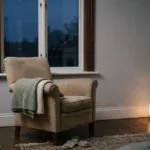
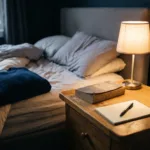
Everything above points to the same practical conclusion: the 4 a.m. version of you should have nothing to decide. The lamp, the book, and a bookmark live where you will actually sit, not on the nightstand where the phone charges. A blanket or sweater is there too, because the point of getting up is not to get cold and give up. None of this is exotic. It’s a reading nook that exists for one hour of the night.
That’s the whole setup, and it rests on thin evidence: a handful of expert opinions, one small lab study of evening screens, and one large online trial of bedtime reading. What nobody has measured is the 4 a.m. page itself.
Which means the best test left is the one you can run on yourself, and it doesn’t start at 4 a.m. It starts tonight, with choosing which book you will be reaching for when you’d rather not choose anything at all.
References
- The People’s Trial, “The Results” (NUI Galway; published in Trials, 2021/2022), thepeoplestrial.ie/phase-seven/the-results/
- Luis F. Buenaver, Johns Hopkins Medicine, “Up in the Middle of the Night? How to Get Back to Sleep,” hopkinsmedicine.org
- Tom’s Guide, “Reading in bed was causing me to wake up at 3 a.m. — until an insomnia expert made this simple routine tweak,” tomsguide.com
- Chang AM, Aeschbach D, Duffy JF, Czeisler CA. “Evening use of light-emitting eReaders negatively affects sleep, circadian timing, and next-morning alertness.” PNAS 112(4), 2015. pnas.org/doi/10.1073/pnas.1418490112
- Harvard Medical School, “E-readers foil good night’s sleep,” hms.harvard.edu; ScienceDaily, “Light-emitting e-readers before bedtime can adversely impact sleep,” Dec 22, 2014
- Sleep Foundation, “Reading and Sleep: Does Reading Before Bed Help You Sleep?” sleepfoundation.org

Diana Woods researches and writes about sleep, environment and everyday habit. She has no clinical training, and that shapes what this site does: instead of explaining what might be wrong with you, she reads the behavioural and environmental research and writes about the parts you can act on — the light in the hallway, the fifteen feet to the bathroom, what the morning does to the night that follows.
Every article here cites its sources, and she tries to include the parts researchers themselves flag as uncertain. Studies disagree, sample sizes are small, and correlation gets reported as cause more often than it should. Saying so is part of the job.