

KEY TAKEAWAYS
- A blackout comes from finding every light source, not from buying a curtain. Lie where your head goes, give your eyes at least five minutes, and look once at night and once at first light. Phone light-meter apps aren’t reliable enough to replace your eyes.
- Laboratory evidence compares a room at about 100 lux with one under 3 lux, and found lighter sleep in the brighter room. I found no study of the levels in between, so “pitch black” is a goal, not a tested threshold.
- Closed eyelids let some light through, more red than blue. How much is disputed, and I found no study testing whether it changes sleep in an already dim room.
- In one study, young adults who wore light-blocking masks did a little better on next-day tests than without them. The effects were small, and a mask handles light you can’t fix at the source.
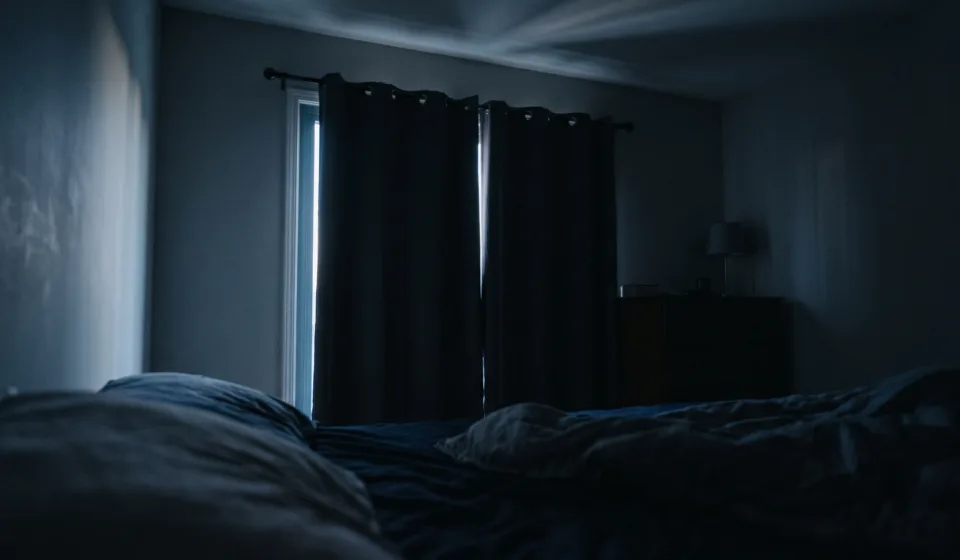
At 4:50 on a June morning there’s a pale blade of light along the left edge of the curtains. You bought blackout curtains. You remember checking the label. And yet there it is, about as wide as a ruler, creeping across the ceiling as the sun comes up, and you lie there watching it, a little offended.
The curtains aren’t broken. They cover the window, which is the job. The light is going around them: past the end of the rod, through the seam where the two panels almost meet, or off the mirror that catches the crack and throws it onto the wall above your head.
So this is about finding that light, and it’s more a way of looking than a shopping list. It takes ten minutes or so, lying in your own bed. Along the way we’ll get to what the research says about how dark “dark enough” is, and fair warning, the answer is a lot shorter than most guides make it sound.
Nobody has tested “pitch black”
Here’s what the evidence actually covers. In a 2022 laboratory study published in PNAS, twenty young adults spent a couple of nights in a sleep lab. Ten of them slept both nights in dim light, under 3 lux. The other ten got one dim night and one under overhead room lighting, around 100 lux [1]. On the bright night their sleep shifted toward the lighter stages, with proportionally less deep sleep and less dream sleep.
That’s the entire range anyone tested in that study: a dim room and a lit one. Curtain retailers like to talk about “zero lux,” and plenty of guides will tell you the goal is pitch black, but I couldn’t find a study showing that 3 lux sleeps better than 10, or that 0 beats 3. What the data supports is more modest. A lit room is worse than a dim one. And a strip of light under a door is a long way from a ceiling fixture.
Phyllis Zee, one of the study’s authors, offered a simple rule of thumb in Northwestern’s news release: if you can see things really well, the room is probably too bright [2]. It’s an informal test, and a sensible one, and it happens to be one you can run tonight.
Before anyone gets carried away, it was twenty people, all young, one night in each condition, and the light came from the ceiling, not from a crack at the edge of a curtain. It points in a direction. It doesn’t draw a line.
How to black out a bedroom when you can’t measure it
Your first instinct might be a light-meter app. I wouldn’t trust it. The lighting-software company DIAL compared seven apps on seven phones against a calibrated meter, and the results were all over the place. Android and Windows phones tended to read about 60 percent too high, iPhones about 60 percent too low, and the error shifted with the light level: one app read 180 percent high in dim light and 50 percent low in brighter light [3]. The page is undated, the company sells lighting software, and the test used LED light, so I’d hold the exact numbers loosely. What matters is the pattern. An app can’t tell you whether a leak is a lot or a little.
Your eyes can’t give you lux either, but they’re very good at the one thing you need, which is where. So use them, and use them twice: once late in the evening with the house dark and the outside lights still on (the streetlight, the neighbor’s porch lamp), and once at first light, before the alarm. The two visits catch different things. The first shows what comes in at night, the second what the sunrise finds.
Lie down where your head goes and give it a while. Five minutes at least, because the faint leaks are the last to show up. Standing by the door with your eyes still tuned to the hallway tells you almost nothing about what reaches the pillow.
Then look around, slowly. The window first: the top edge, both sides, and the seam where the panels meet. The door next, the gap underneath, the edges, the keyhole, and whatever’s on the other side of it, because a hallway window or a bathroom fan light keeps its own schedule. Then the room itself, where there’s usually a standby light, a charger, a smoke detector, a clock face. And anything shiny, because a mirror, a glossy wardrobe door, the glass on a picture frame or a switched-off screen can turn a thin leak into a wide patch somewhere you didn’t expect.
As you find each one, jot down where it comes from and whose it is. A charger is yours, and it’s a ten-second fix. A partner’s reading lamp or a neighbor’s floodlight is a conversation, or a different kind of fix.
The fixes are mostly dull, and I haven’t seen anyone test them: a curtain rod wider than the window so the fabric overlaps the frame, a towel along the bottom of the door, a small square of opaque tape over a standby light, a mirror turned a few degrees. That’s common sense talking, not research. Start with whichever leak is brightest at the pillow.
Closed eyes aren’t a switch
Even then, the light doesn’t have to get past your eyelids to count, because eyelids let some of it through.
A classic measurement from Ando and Kripke in 1996 put the share of red light getting through at about 6 percent [4]. Earlier studies had come up with anything from roughly 0.3 to 14.5 percent. Then in 2022 a team at Osaka Metropolitan University tested 33 volunteers with light across the whole face at about 100 lux and reported values up to ten times higher than those older numbers. Red light looked brighter with the eyes shut than blue did, and some people noticed hardly any difference between open and closed [5].
It helps to be clear about what that does and doesn’t mean. The volunteers were awake, telling researchers how bright things looked, under 100 lux. Nobody was asleep and nobody measured sleep, and I couldn’t find a study testing whether the light that gets through changes how someone sleeps in a room that’s already dim. So it’s a reason to doubt “my eyes are closed, so it doesn’t matter.” It isn’t a reason to lose sleep over a charger LED.
There’s one wrinkle if you’ve followed the usual advice on night lights. Warm amber or red ones are a common recommendation, because they feel gentler when you’re awake. If red also passes through eyelids best, the open question is small: does it matter for a light that stays on while you sleep? For one that comes on while you shuffle to the bathroom, nothing I found suggests it does.
And if the room won’t cooperate
Sometimes the room just can’t be fixed. A rental, a shared bedroom, a partner who reads late. Then there’s the mask, which has a study of its own. Viviana Greco and colleagues recruited 89 young adults, then 33 more, all between 18 and 35 [6]. They wore a light-blocking mask at home, for a week in the first group and four nights in the second, and were compared with going without a mask or wearing one with holes cut over the eyes. After mask nights people did a little better at learning word pairs, and reacted a little faster on an alertness task: about six thousandths of a second, 310 against 316 milliseconds. In the smaller group, whose sleep was tracked with a headband, more time in deep sleep went along with better learning on mask nights and not on control nights.
The effects were small, the volunteers were young, and it didn’t run long. The authors also note that the masks differed in comfort, and that participants were told to keep their curtains or shutters open, which may not reflect real bedrooms.
I’d think of it as a different tool for a different part of the problem. A mask deals with the light that reaches your eyes. The audit deals with where it comes from. They’re not rivals, and nothing stops you from using both.
Tomorrow, at first light
Before you order anything, go and look. Tomorrow at first light, lie down where your head goes, give your eyes a few minutes, and let the room show you its list. Whatever you notice first is where to start. And if nothing stands out, that’s a result too.
References
- Mason IC, Grimaldi D, Reid KJ, Warlick CD, Malkani RG, Abbott SM, Zee PC. Light exposure during sleep impairs cardiometabolic function. Proc Natl Acad Sci U S A. 2022;119(12):e2113290119. doi:10.1073/pnas.2113290119
- Northwestern University news release on Mason et al., March 14, 2022; quoted in Medical Xpress. medicalxpress.com
- DIAL GmbH. Luxmeter app versus measuring device: are smartphones suitable for measuring illuminance? Undated. dialux.com
- Ando K, Kripke DF. Light attenuation by the human eyelid. Biol Psychiatry. 1996.
- Sakai H, et al. Perception of brightness when the eyes are closed. Color Res Appl. 2023. Osaka Metropolitan University news release, December 19, 2022.
- Greco V, Bergamo D, Cuoccio P, Konkoly KR, Muñoz Lombardo K, Lewis PA. Wearing an eye mask during overnight sleep improves episodic learning and alertness. Sleep. 2023;46(3):zsac305. doi:10.1093/sleep/zsac305

Diana Woods researches and writes about sleep, environment and everyday habit. She has no clinical training, and that shapes what this site does: instead of explaining what might be wrong with you, she reads the behavioural and environmental research and writes about the parts you can act on — the light in the hallway, the fifteen feet to the bathroom, what the morning does to the night that follows.
Every article here cites its sources, and she tries to include the parts researchers themselves flag as uncertain. Studies disagree, sample sizes are small, and correlation gets reported as cause more often than it should. Saying so is part of the job.