


Key Takeaways
- Most bedroom-temperature advice gives one range for one sleeper. The popular guide I checked cites no source for its range and says nothing about two people sharing a bed.
- In the research I could read, too much heat costs more sleep than a cooler room does, as long as the bedding is adequate. So when the room has to lean toward one person, the thin evidence leans slightly toward the one who runs warm, with the cooler sleeper adding layers.
- On average, women report being less satisfied with room temperature and more often uncomfortably cold. An average is not a rule for your bed, and the difference isn’t a flaw in either of you.
- In one diary study, households that reached agreements or compromises adjusted the thermostat more often than those stuck in conflict. Settle it in daylight, not at 2:40 a.m.
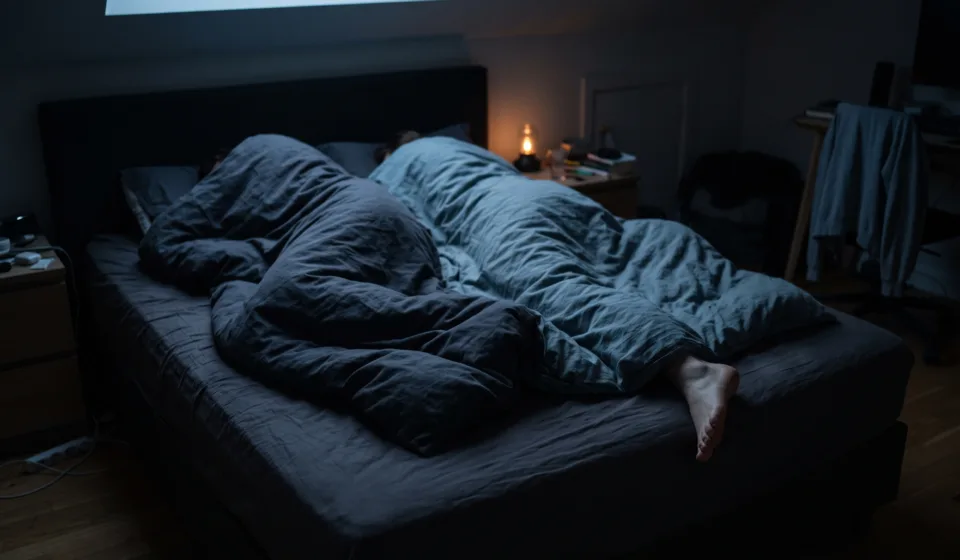
At 2:40 a.m. one of you has a foot out from under the duvet, and the other has pulled it up to the chin. Neither is asleep. Neither says anything until morning, when it comes out as a remark about the thermostat, delivered to the coffee maker.
It sounds like an argument about degrees. Mostly it isn’t. There are two separate problems tangled together here, the temperature of the room and the temperature of each person’s half of the bed, and they have different fixes. One has to be shared. The other doesn’t.
This piece pulls them apart, using what I could find in the research on warmth, bedding and sleep, plus a small amount of work on how households actually settle this fight. Fair warning: very little of it was done on two adults in one bed, and I’ll say where each source runs out.
Why the usual answer doesn’t settle anything
Search for the right bedroom temperature and you get a number. The Sleep Foundation’s page, updated in July 2025, says most doctors recommend a thermostat setting of 65 to 68°F (15.6 to 20°C), with about 65°F the best for sleep [1]. It adds that the ideal may vary by a few degrees from person to person.
I’m not picking on them. Plenty of guides look like this, and the range is a reasonable place to start. But I couldn’t find a source tied to that range on the page, and it says nothing about two people sharing a bed. A range is built for one sleeper. Hand it to a couple with different needs and it becomes ammunition: whoever feels cold points out that it’s below 68, whoever feels hot points out that it’s above 65.
Bedroom temperature for couples: the room is shared, the bed doesn’t have to be
Start with what’s known about what each kind of mistake costs, because it isn’t symmetrical.
A 2012 review by Kazue Okamoto-Mizuno and Koh Mizuno pulled together the research on thermal conditions and sleep. Heat exposure increased time awake and reduced deep sleep and dream sleep, and humid heat made it worse. Cold exposure was different. In their reading, it didn’t change the sleep stages, and what mattered most was whether people had enough bedding and clothing to stay comfortable [2].
One small laboratory study points the same way. Tsuzuki and colleagues had young men sleep under bedding at 3, 10 and 17°C (roughly 37, 50 and 63°F) and found no significant differences in sleep stages or total sleep time across the three [3]. I’d hold that one loosely: the participants were all young men, the group was small (the paper doesn’t spell out the number in the text I could read), and most of the comparisons simply came out non-significant. It is not a reason to switch off the heat. It does suggest that in a bed that’s well covered, the air temperature may matter less than we assume.
Put the two together and a pattern shows up, though a thin one. Too warm seems to be the costlier miss. Too cool seems to be one that covers can mostly fix. If the room has to lean toward one person, the evidence, such as it is, leans a little toward the one who runs warm, with the cooler sleeper adding layers on their side.
That’s an inference, not a finding. The review dates from 2012, and nobody tested any of this on couples. Treat it as a tiebreaker, not a ruling.
“You’re both right” is closer to literal than it sounds
In Finland, Sami Karjalainen ran an interview survey of 3,094 people along with some controlled experiments, across homes, offices and a university [4]. Women were less satisfied with room temperatures than men, preferred higher temperatures, and more often said they were uncomfortably cold or uncomfortably hot. Men were the ones who touched household thermostats more often.
Eight years later, two researchers wrote a short commentary in Nature Climate Change arguing that the standard comfort model used to set building temperatures was built around an average male body, so the temperatures it calls comfortable may run cool for women [5]. That one is an argument, not a trial, and it’s about offices rather than bedrooms. I’ve only been able to read its abstract.
Now the part that matters if you’re the one in the bed. These are averages across thousands of people, and an average says nothing about the two people in your bed. I’d expect plenty of men who run cold and plenty of women who run hot. The study doesn’t tell you which of you is which, and it doesn’t tell you why, so I wouldn’t use it to win anything. What it does tell you is that a difference in what feels right isn’t a flaw in one of you. It’s ordinary, it shows up in surveys of thousands, and both of you are reporting accurately.
There’s also the matter of what counts as “comfortable” for any one person. Cao and colleagues tested 18 young adults, around 23 years old, at set temperatures and humidities, and found their neutral points at about 20°C in winter (68°F) and 26°C in summer (79°F), which is why the paper gives separate numbers for each season [6]. Eighteen people, one age band, no couples. Useful as a reminder that the ideal moves with the season and the bedding, and not much else.
What the argument itself does
Here’s the odd finding that stayed with me. A team at Ohio State had 112 people in central Ohio households with at least two occupants keep a diary about their thermostat, a night at a time, for a week or two, producing 1,568 entries in all [7]. They sorted the exchanges into three kinds: agreements, compromises (a disagreement that ended in agreement), and conflicts (a disagreement that stayed one).
Agreements and compromises were linked to someone actually adjusting the thermostat that day. Conflicts weren’t. In that sample, men were more likely to report agreements and compromises, and women were marginally more likely to report conflicts.
The authors call this an early step, and the limits are real. It’s self-report, from one region, and it leaves out other gender identities. The authors also note, in Ohio State’s news release, that the gender gap could reflect perception, since what one partner calls a compromise the other may experience as losing. It also says nothing about sleep. I’m reading the diaries and the release, not the full paper.
Still, the practical drift is hard to miss. The fights that don’t resolve are the ones where nothing changes, and the fight at 2:40 a.m. is the least likely place for a resolution. Nobody’s persuasive at that hour. Everybody is just cold or hot.
Two questions, asked in daylight
So separate them, and settle both when neither of you is awake enough to be annoyed. None of this is tested, it’s common sense built on the studies above.
The first question is what the room does overnight. This is the shared one, and it needs a single answer. A reasonable place to start is the cooler end of what you can both stand, given the lopsided cost of too much heat. Set it once, in the afternoon, and then leave the dial alone until the next time you change it deliberately.
The second is what each side of the bed does. This one doesn’t need to match. Separate coverings, a lighter layer on one side and a heavier one on the other, a throw folded at the foot of the colder sleeper’s side, or a small fan aimed at the warmer one. The aim is for each of you to fix your own temperature without waking the other, which is the whole difficulty with a shared blanket.
Then run it as an experiment. For a week, change nothing else. In the morning, each of you says whether temperature woke you, and which side of the bed it came from. That’s all. If the answers stop clustering on one side, you’re done. If one side keeps coming up, you’ve found the layer to change, and you’ve found it without a debate.
It’s also worth noticing that you’re negotiating something neither of you can fully see. You feel your own side from the inside, and only your own. The other person’s discomfort reaches you as a thump, a sigh, a duvet being yanked.
Who gets to be right
Somewhere in this is a question the research can’t answer, which is how two people decide a room belongs to both of them. A number on a dial won’t settle it, and neither will a study. The more useful question for tonight might be smaller. When you next wake up too warm or too cold, was it the room, or was it your half of the bed? The answer decides whether you’re reaching for the thermostat or for the blanket.
References
- Sleep Foundation. “Best Temperature for Sleep.” Updated July 11, 2025. sleepfoundation.org
- Okamoto-Mizuno K, Mizuno K. Effects of thermal environment on sleep and circadian rhythm. J Physiol Anthropol. 2012;31(1):14. doi:10.1186/1880-6805-31-14
- Tsuzuki K, Okamoto-Mizuno K, Mizuno K. The effects of low air temperatures on thermoregulation and sleep of young men while sleeping using bedding. Buildings. 2018;8(6):76.
- Karjalainen S. Gender differences in thermal comfort and use of thermostats in everyday thermal environments. Build Environ. 2007;42(4):1594-1603. doi:10.1016/j.buildenv.2006.01.009
- Kingma B, van Marken Lichtenbelt W. Energy consumption in buildings and female thermal demand. Nat Clim Change. 2015;5(12):1054-1056. doi:10.1038/nclimate2741
- Cao T, Lian Z, Zhu J, Xu X, Du H, Zhao Q. Parametric study on the sleep thermal environment. Build Simul. 2022;15:885-898. doi:10.1007/s12273-021-0840-5
- Sintov ND, White LV, Walpole H. Thermostat wars? The roles of gender and thermal comfort negotiations in household energy use behavior. PLoS ONE. 2019;14(11):e0224198. doi:10.1371/journal.pone.0224198. Additional detail from the Ohio State University news release, “First look at thermostat wars suggests women may be losing these battles,” news.osu.edu

Diana Woods researches and writes about sleep, environment and everyday habit. She has no clinical training, and that shapes what this site does: instead of explaining what might be wrong with you, she reads the behavioural and environmental research and writes about the parts you can act on — the light in the hallway, the fifteen feet to the bathroom, what the morning does to the night that follows.
Every article here cites its sources, and she tries to include the parts researchers themselves flag as uncertain. Studies disagree, sample sizes are small, and correlation gets reported as cause more often than it should. Saying so is part of the job.