

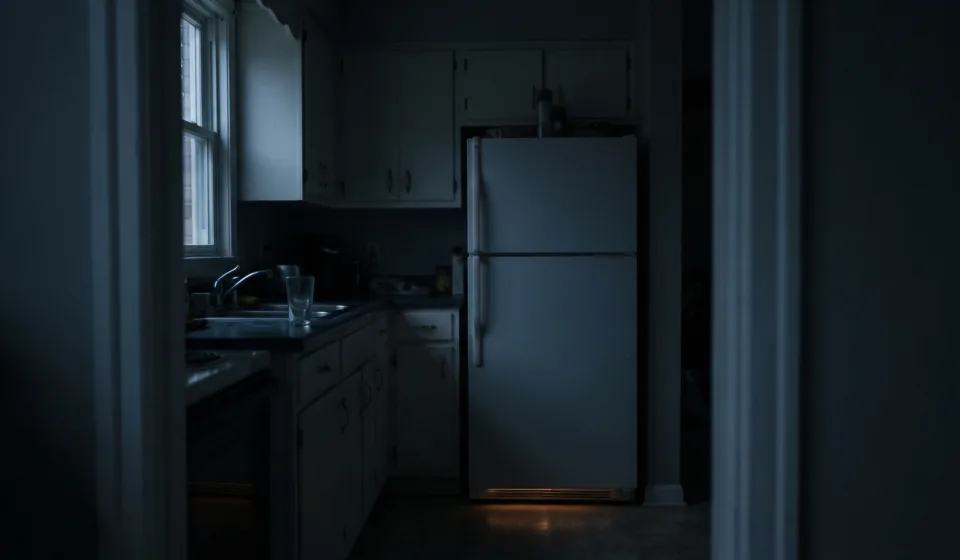

At 3:40 a.m. the refrigerator downstairs clicks off, and the quiet that follows is so complete it sounds like something. You never heard the compressor running. You’d have told anyone the house was silent. Then it stopped, and you found out it had been talking all night.
Noise in a bedroom works like that. Some of it fades from your awareness within minutes. Some of it, as far as anyone can measure, keeps reaching you whether you notice or not. And the two lists don’t match: what annoys you isn’t reliably what wakes you, and what you’ve learned to ignore may not have returned the favor.
So this is a way to sort the sounds in your room into the ones worth doing something about, based on what the research shows and where it goes quiet. It won’t hand you a safe number of decibels. Nobody has a number that fits your bedroom, and I’d be wary of anyone who claims to.
Getting used to it is a feeling, not a measurement
Start with the finding that gets mangled most when it’s retold. At the German Aerospace Center’s institute in Cologne, a team led by Mathias Basner had 72 men and women, aged 18 to 71, sleep in a lab for 11 nights in a row while recordings of aircraft, road and rail traffic played, the loudest events somewhere between 45 and 65 decibels [1].
Two results are worth keeping. The volunteers rated aircraft noise the worst nuisance. But it was the sudden road and rail noise that did more damage to the structure of their sleep, more than the slow swell of a plane going over. So the speed at which a sound shows up seemed to count as much as its peak. And the institute’s write-up says that on one measure the team tracked, “there was no getting used to the noise”: after several nights, the sounds still made volunteers’ hearts speed up.
Put those together and you get an uncomfortable idea. The sound that bugs you most and the sound that does the most to your night can be two different sounds, and feeling like you’ve adapted doesn’t prove your body has.
I’d hold that loosely. It was a laboratory, with recordings played to volunteers, and I’ve only read the institute’s summary, not the paper. A body response during sleep isn’t the same as a bad night, and the study doesn’t say it is. It’s a reason to doubt the comfortable “I don’t even hear it anymore,” not proof that you should.
Bedroom noise at night: when it arrives matters more than how loud it is
Real bedrooms tell a slightly different story. A Swiss group including Martin Röösli had 105 volunteers wear wrist movement sensors for a week while microphones recorded the noise outside their bedroom windows [2]. The timing is what jumped out. Noise in the first hour after bedtime went with taking longer to fall asleep. Noise in the last few hours of the night went with lower sleep efficiency, about 2 to 3 percent for each 10-decibel increase, by the authors’ numbers. And noise in the hour before waking tracked most closely with how sleepy people said they felt.
The authors read it this way: the start and the end of the night are the touchy parts, and averaging noise across the whole night hides that.
The usual caution applies, and it’s a big one. This is observational, so people on loud streets differ from people on quiet ones in plenty of other ways. The noise was measured outdoors, and what reached the pillow was estimated. It was one week per person. I’d treat it as a pattern worth testing in your own house, not a rule.
Still, it’s easy to use. A delivery truck at 5 a.m. and a television through the wall at 11 p.m. are different problems even at the same volume, because they hit different parts of the night.
What about the machine on the nightstand?
Ask anyone about bedroom noise and you’ll be steered toward a sound machine. It’s the one fix everybody knows, so it deserves a look.
The best overview I found is a 2021 systematic review by Riedy, Smith, Rocha and Basner, covering 38 studies of noise used as a sleep aid [3]. The authors rated the evidence that continuous noise improves sleep as very low quality. Lots of the studies were tiny, many with 10 or fewer people. They leaned on self-report, described the noise badly, and landed all over the place, with positive, negative and null results. At least one found more broken-up sleep with white noise.
What I like about it is that it doesn’t say the machines fail. It says the data don’t show they work as advertised, and that continuous noise can’t yet be promoted as a sleep aid. If you already own one and like it, nothing here says to throw it out. If you’re about to buy one to deal with a particular knocking pipe, the evidence for that specific job is thin. (I read this through a summary aimed at clinicians, not the full review, so check the original before quoting numbers.)
Sort the sounds before you buy anything
Here’s the part that isn’t research, only what follows from it. For three nights, keep a pen and a scrap of paper by the bed, and whenever something wakes you, jot down four things.
First, what kind of sound it was: steady, like a fan or a distant road, or sudden, like a door, a pipe, a car. The traffic study hints that sudden ones deserve more suspicion than their volume suggests. Second, roughly when: the first hour, the middle, the last stretch. The field study says the ends are where timing counts. Third, whose it is. Yours, like an appliance or a phone alert, is a fix. Someone else’s, like a neighbor, a street or the person next to you, is a conversation or a different kind of fix.
The fourth is the one people skip: did it come before you woke, or after? A sound you only noticed once you were already awake isn’t necessarily what woke you. The refrigerator’s a good example. The hum was there all night. What you noticed at 3:40 was the click when it stopped.
Then go after the shortest list. Sudden sounds with a source you control come first: a door that clicks shut, a pipe that knocks when the heat comes on, a phone that buzzes against a wooden nightstand. Most of those have boring fixes (a felt pad, a different spot for the phone, a door that closes gently), and none has been tested as a sleep intervention. It’s common sense. Change one, leave the rest alone for a week, and see whether the notes change.
The steady sounds are a tougher call. If there’s one you’ve stopped hearing, that one laboratory finding is a reason not to assume it has stopped affecting you. It’s not a reason to panic. It’s a reason to put it on the list.
The hum you only hear when it stops
The refrigerator isn’t really the problem. It’s a reminder of how much of your room you’ve stopped listening to, and how little of that you’ve actually checked. Tonight, before you turn off the light, stand in the doorway for ten seconds and listen to the house. What’s been running all along?

Diana Woods researches and writes about sleep, environment and everyday habit. She has no clinical training, and that shapes what this site does: instead of explaining what might be wrong with you, she reads the behavioural and environmental research and writes about the parts you can act on — the light in the hallway, the fifteen feet to the bathroom, what the morning does to the night that follows.
Every article here cites its sources, and she tries to include the parts researchers themselves flag as uncertain. Studies disagree, sample sizes are small, and correlation gets reported as cause more often than it should. Saying so is part of the job.