

KEY TAKEAWAYS
- What lights your face during the awake hour likely matters more than the room you are in. Two lab studies of evening light found that room light and screen light pushed the body’s night signals the wrong way. Neither tested a 3 a.m. lamp.
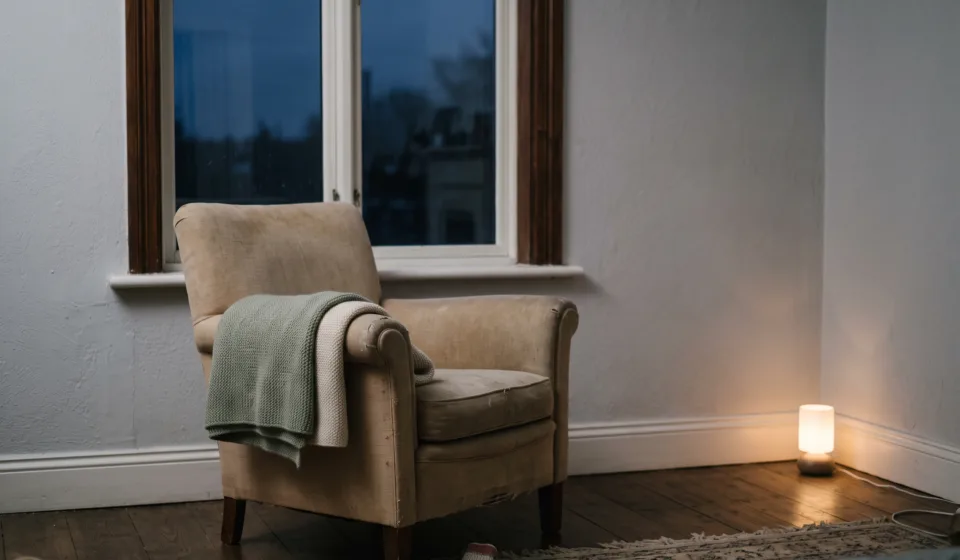
- A good chair spot has four parts: it is off the bed, it faces away from the bed, it has no light of its own beyond something small and warm, and it has a blanket within reach.
- The window is there for the dark, not the view. If a streetlight lands on the chair, the spot fails, and a cheap fix beats a better chair.
- Nobody has tested a chair by a window against a bed. What follows is reasoning built on lighting studies, and it says so where it matters.
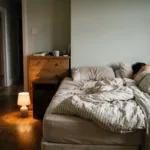
You wake, and you know within a few seconds that you are not going straight back. So you do what most people do. You sit up on the edge of the bed, or lie propped on a pillow, and the phone comes off the nightstand. Its glow lights your chin. The bed is warm behind you and the room is dark, and you have made yourself the brightest thing in it.
There is another option that costs almost nothing: a chair, across the room, near a window.
That is the whole idea. A spot that is not the bed, that is dim on purpose, that you can settle into without lighting anything and leave without noise. What the spot needs, where it goes and what it should never hold are the parts worth getting right, and none of them require buying anything.
Why the light on your face is the real problem
The best-known studies here are about evenings, not the middle of the night, so they need careful handling. In 2011, Gooley and colleagues published a study in the Journal of Clinical Endocrinology and Metabolism on 116 healthy volunteers aged 18 to 30. Exposure to ordinary room light in the hours before bed, compared with dim light, shortened the duration of the body’s night signal by about 90 minutes. [1]
In 2015, Chang and colleagues at Brigham and Women’s Hospital in Boston tested something closer to what people do in bed. Twelve healthy young adults spent two weeks in a lab, reading for about four hours before bed on a light-emitting tablet for five evenings, then from printed books in dim light for five more. After the tablet evenings, people took about ten minutes longer to fall asleep, their internal clocks ran later by more than an hour and a half, and they were less alert the next morning. [2]
The caveats are real and they matter. Both studies used young, healthy volunteers in a lab. Both looked at the evening, not the small hours. The tablet was set to maximum brightness, and four hours of reading is more than anyone does at 3 a.m. Neither study says what a phone does over ten minutes in the dark, and I did not find one that does.
What they do give is a direction. In these studies, brighter light and screen light moved things the wrong way, and dim light did not. That is all a chair by a window needs to lean on. Move yourself away from the biggest light in the room, and make the light you do keep small.
The four parts of the spot
The chair. Any chair you can sit in without effort will do, but two features help. It should be a chair you can get into without turning a light on, and it should face away from the bed, so the bed is not the thing you are looking at. A worn armchair is better than a stiff dining chair. A stool is not a chair.
The blanket. Put one within reach of the seat, folded on the arm or over the back. The reason is practical: you have just left a warm bed, and a cold room pushes people back to bed too fast or into turning on a light to check something. A blanket by the chair takes both options off the table. Nobody has studied it. It is plain reasoning about a shared problem.
The light. Michigan Medicine, in its guidance on bedroom lighting, says that if you tend to wake up at night to use the restroom, a small night light in the bedroom is fine to guide you out of the room. It also suggests dim or red lights before bed rather than bright ones. That is advice, not a study, and the page does not cite specific ones. [3] But it lines up with the two studies above: keep the light low, keep it warm, and keep it out of your eyes. A small lamp on the floor behind the chair, or in the corner, does more than a bright one overhead.
Then there is the window, which is the part nobody writes about.
Why a chair by the window at night needs a dark window
The word in “chair by the window” that people skip is the window itself. It is not there for the view. It gives you a reason to sit facing away from the bed, and a dark sky is a dim thing to look at, as long as the light outside stays outside.
That only works if the window is dark. If a streetlight, a neighbor’s porch light or a parked car’s dashboard reaches the chair, you have swapped a phone for a spotlight. Check it once, at night, from the chair itself. Sit in it for a minute with the room lights off and notice where the light lands: on your lap, on your face, on the floor. If it lands on you, there are three cheap fixes. Turn the chair a quarter turn. Drop a sheer curtain across the window, or a heavier one across the streetlit half. Or move the chair to the corner where the light does not reach.
My own rule of thumb, not a tested one: if you can read the label on something across the room, the spot is too bright.
What the chair should never hold
This is the part that does the work. The chair is a place to be awake without doing anything you would not do in the dark. It holds no phone, no tablet and nothing with a screen. It holds no work. It does not become a desk or a place to check the time.
You can put a book on the arm, but that is a different question, and a book brings its own light problem. For the chair itself, empty hands are the default. Look at the window, breathe slowly, and let the room be dark. Slow breathing is a practice, not a treatment, and nothing here claims it will send you back to sleep.
The honest limit of all of this is that nobody knows whether it will. The studies show what bright light does to evenings. They do not show what a chair does to a wakeful hour. What the chair spot does is take away two things you control, the lit screen and the bright room, and leave you a quieter hour than the one you were having. Some nights that hour ends in sleep. Some nights it does not, and you have lost nothing by trying.
Leaving the chair
There is no right time to leave it. The chair is not a timer. You will know, or you will not, and either is fine. What matters more is the way back: no lamp, no phone, the same slow steps you used to leave. If you share the bed, the same rules apply on the return trip as on the way out.
If you tried the spot for a week and never once used it, take that as information about the spot. Maybe the light lands on you, or the chair is too far from the bed, or it is cold. The first fix is almost always the window.
One small change tonight
Set the chair now. Turn it away from the bed. Fold the blanket over the arm. Sit in it once with the lights off and see where the light falls. Do it before you need it, because the hour you need it is the worst time to set it up. And the next time you wake, it will be sitting there in the dark, waiting, without asking anything of you.
REFERENCES
- Gooley JJ, Chamberlain K, Smith KA, et al. Exposure to room light before bedtime suppresses melatonin onset and shortens melatonin duration in humans. Journal of Clinical Endocrinology & Metabolism, 2011;96(3):E463–E472. https://academic.oup.com/jcem/article-abstract/96/3/E463/2597236
- Chang AM, Aeschbach D, Duffy JF, Czeisler CA. Evening use of light-emitting eReaders negatively affects sleep, circadian timing, and next-morning alertness. Proceedings of the National Academy of Sciences, 2015;112(4):1232–1237. https://www.pnas.org/doi/10.1073/pnas.1418490112
- Michigan Medicine. How to Use Bedroom Lighting to Improve Sleep Quality. Health Lab. https://www.michiganmedicine.org/health-lab/how-use-bedroom-lighting-improve-sleep-quality

Diana Woods researches and writes about sleep, environment and everyday habit. She has no clinical training, and that shapes what this site does: instead of explaining what might be wrong with you, she reads the behavioural and environmental research and writes about the parts you can act on — the light in the hallway, the fifteen feet to the bathroom, what the morning does to the night that follows.
Every article here cites its sources, and she tries to include the parts researchers themselves flag as uncertain. Studies disagree, sample sizes are small, and correlation gets reported as cause more often than it should. Saying so is part of the job.