

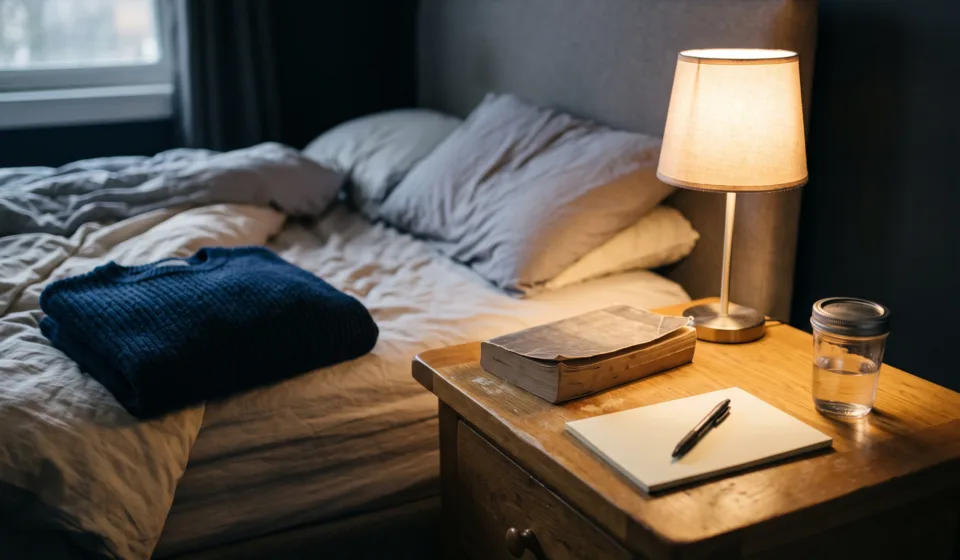

Key Takeaways
- The test for anything on a nightstand is whether your hand finds it in the dark without a decision. If it takes a decision, it’s in the wrong place.
- Only two of the six items here have research behind them, and in both cases the research is indirect. The rest is logic about what you do with your hands at 3 a.m.
- The one item with a real experiment is the least obvious: a pad and a pen, used to write down what’s coming up, not what you’ve done.
- The most common failure isn’t a missing item. It’s the phone, because it’s the only thing on the nightstand that was designed to be picked up.
It’s 3:12 and your hand goes out across the nightstand on its own. It knocks the glass, finds the charger cable, follows it to the phone. The screen lights the ceiling before you’ve decided anything. You were not going to look at the phone. Your hand was.
That’s the whole problem with a bedside table at night. In the daytime it’s furniture. At 3 a.m. it’s an interface, and your hand is the only thing using it. What your hand finds first becomes what you do next.
So the setup below is built for the hand. Six things, each within reach, each chosen so the first thing you touch isn’t a screen. Two come with research. Four are just the logic of the dark, and I’ll say which is which.
One: a lamp you can switch on without looking
Start with the light, because everything else depends on it. The Sleep Foundation’s advice for waking at night is to avoid bright light and use dimmers, low lamps or night lights instead. That’s the expert guidance. It isn’t a measurement of anyone’s 3 a.m.
What the lamp needs is practical. A switch your fingers can find by feel: a rocker, a dial, a touch base you’ve already tested blind. A shade that keeps the light on the table and off your eyes. A bulb that doesn’t come up at full strength, because a lamp that arrives at full strength is the overhead light with better manners.
Test it once, in the dark, with your eyes closed, in the position you wake in. If you can’t find the switch, the lamp doesn’t count.
Two: a paper book, already open to a page you don’t mind
A physical book is the item the Sleep Foundation names directly: something light or familiar, nothing too thrilling or emotionally intense. Dr. Jose Puangco, a neurologist and sleep medicine specialist quoted by Yahoo Health, suggests a few pages of a low-key book.
The reason it earns a place on the nightstand and not in a drawer is the same reason as the lamp. If you have to get up and find it, it’s a project. If it’s under your hand, it’s a decision you made yesterday.
One small rule: keep the book for this hour only. A book you’re excited about is a book you’ll read until dawn.
Three: a pad and a pen, for what’s coming up
This is the item with an actual experiment, and the detail most summaries blur is which way the writing points.
Michael Scullin and colleagues, in the Journal of Experimental Psychology: General (2018), had 57 healthy young adults spend a night in a sleep lab. Each person spent five minutes before bed writing. One group wrote a to-do list of what they needed to remember over the next few days. The other group wrote about what they had already done. The people writing about upcoming tasks fell asleep faster.
Read that twice. It wasn’t journaling that helped. Journaling about the finished day was the comparison, and it did worse. What helped was handing the unfinished work to a piece of paper.
The caveats are real. Fifty-seven students is a small group. They were healthy young adults, which the researchers themselves note limits what can be said about anyone else. And the writing happened at bedtime, not at 3 a.m. Moving it to the middle of the night is my inference, not their finding. The logic is that the hour when the list rewrites itself in your head is the hour a pad would be most useful. The evidence doesn’t go that far.
Practical details: a pad that doesn’t need a light to be written on, a pen that works upside down or at an angle, and a rule that you write the next-few-days list, not a review of the day.
Four: something to put on
This one has no research. It’s the plainest item on the list and the one most often missing.
If you decide to leave the bed, which the Sleep Foundation suggests after about twenty minutes of lying awake, you will be cold, or you’ll become cold, and the quickest way back to the bed is to abandon the plan. A robe or a sweater on the bedpost, within reach, turns “I’ll get up” from an act of will into a logistics step.
Put it where your arm falls. Not in the closet.
Five: water, in something that won’t tip
Also no research, so take it as housekeeping. A glass you can find in the dark will eventually be knocked over in the dark. A bottle with a lid, or a glass set well back from the edge, saves you the one bright task of the night: turning on the overhead light to deal with a spill.
If you don’t want water, skip this one. The list is a starting point, not a prescription.
Six: a place for the phone that isn’t your hand
Dr. Bijoy John, a sleep physician quoted by Yahoo Health, says the light from screens “signals wakefulness to the brain.” That’s an expert’s statement about screens in general, not a trial. But the pattern matches what most of us notice.
The phone is the only item on the nightstand built to be picked up, so it has to live somewhere that makes picking it up a choice. Face down, at the far end of the table, or on a charger a step away from the bed. Not under the pillow, and not on the bed.
I can’t point to a study that says where the phone should sit. What I can say is that the phone is also a clock, and Dr. Harneet Walia, a sleep medicine physician also quoted by Yahoo Health, says clock-watching can raise anxiety and make it harder to fall back asleep. Whatever distance you choose, the goal is for the first thing your hand finds to be paper.
What isn’t on the list
A few things people expect to find here aren’t: no diffuser, no white-noise machine, no supplement, no gadget with its own light. Some of those may help some people. None is something I can support with research on waking at night, and several carry a light or a screen of their own.
A nightstand that does one job, which is to keep your hand from finding the wrong thing, is simpler and cheaper than one that tries to do five.
A way to check it
Do one test, and do it during the day. Turn off the lights, lie in bed in your usual position and close your eyes. Reach out and touch each of the six items without looking. If your hand finds the lamp switch, the book, the pad, the layer, the water and the phone’s spot, it’s done. If it finds the phone before anything else, rearrange.
Then do the second test, which only you can run: wake up some night and notice where your hand goes first. That one tells you what the table is really for.
References
- Scullin, M. K., Krueger, M. L., Ballard, H. K., Pruett, N., & Bliwise, D. L. (2018). The effects of bedtime writing on difficulty falling asleep: A polysomnographic study comparing to-do lists and completed activity lists. Journal of Experimental Psychology: General, 147(1), 139–146.
- ScienceDaily. Can writing your “to-do’s” help you to doze? Study suggests jotting down tasks can. (2018).
- Sleep Foundation. What to Do When You Can’t Sleep: 8 Expert-Backed Tips.
- Yahoo Health. The 1 thing you shouldn’t do when you wake up in the middle of the night, according to doctors (quotes Dr. Harneet Walia, Dr. Bijoy John and Dr. Jose Puangco).

Diana Woods researches and writes about sleep, environment and everyday habit. She has no clinical training, and that shapes what this site does: instead of explaining what might be wrong with you, she reads the behavioural and environmental research and writes about the parts you can act on — the light in the hallway, the fifteen feet to the bathroom, what the morning does to the night that follows.
Every article here cites its sources, and she tries to include the parts researchers themselves flag as uncertain. Studies disagree, sample sizes are small, and correlation gets reported as cause more often than it should. Saying so is part of the job.