


KEY TAKEAWAYS
- People differ enormously in how strongly their bodies react to light at night. In one study the gap was more than fiftyfold, so your partner sleeping through the hallway light tells you nothing about yourself.
- In a large lab study, ordinary living-room lighting switched on during normal sleep hours cut the body’s night signal by more than half.
- Brightness seems to matter more than color. A dim warm light can be gentler than a bright red one.
- The light that counts is the light reaching your eyes. A lamp near the floor, pointed down, does far less than the same lamp overhead.
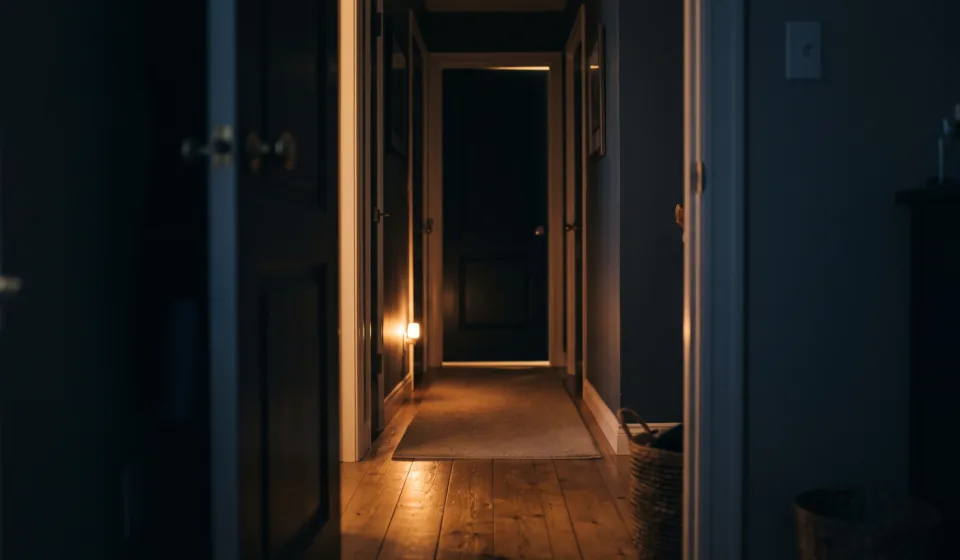
It’s ten to three. You come back from the bathroom and the person you share a bed with hasn’t moved.
The hall light was on the whole time. They switched it on earlier to let the dog out and forgot about it, and they’ve slept straight through. You, on the other hand, are now lying in the dark completely awake, and you can see the ceiling a little too clearly.
It’s tempting to decide one of you is the problem. You’re too sensitive, or they’re oblivious.
The research offers a better explanation, and it’s a little reassuring: you may simply be built differently. Once you know that, the fix gets a lot more specific than “buy a night light.”
Some people are fifty times more sensitive
In 2019, a group of sleep researchers set out to measure how much evening light it takes to affect the body’s sense that it’s night. They published the results in PNAS, and the average figure alone is sobering. Half of the full effect showed up at under 30 lux, which is dimmer than most rooms people sit in after dark and within range of a lit phone screen.
The average wasn’t the headline, though. The spread was.
Between the least and most sensitive participants, the difference was more than fiftyfold. Two people under the same lamp were, biologically speaking, getting very different nights.
So when the person beside you says the light doesn’t bother them, believe them. They’re right about themselves. It just doesn’t carry over to you, and there’s no point arguing about who’s being reasonable.
Normal lighting is more than you’d guess
The older study behind this is from 2011, run by researchers at Harvard and Brigham and Women’s Hospital, and it’s the one people tend to cite when they talk about light at night.
They took 116 healthy volunteers between 18 and 30 and spent several days before bed keeping them either in ordinary room light, under 200 lux, or in dim light, under 3 lux.
Under ordinary room light, the body’s night signal started later and ran about 90 minutes shorter.
Then there’s the part that matters most at 3 a.m. When volunteers got room light during the hours they’d normally be asleep, that signal dropped by more than half.
Nobody was sitting under stadium lights. This was the level most of us consider completely normal for a living room. At three in the morning, normal is a lot.
A caveat, before you rip out the ceiling fixtures
Both of those studies exposed people to light for hours at a time, in a laboratory. Nobody has measured what a ninety-second trip to the bathroom does, and I’d be inventing it if I told you.
The nearest thing we have used real household bathroom lamps for thirty minutes. That was long enough to make people report feeling more alert, which is exactly the wrong direction when you’re trying to get back to sleep.
A quick trip is almost certainly a smaller dose. What the research gives you isn’t a verdict on one trip. It’s a direction, and the direction is less light, from lower down, for less time.
That’s enough to act on.
Red isn’t the cure-all it’s sold as
Most night-light advice ends with a shrug and “get a red one.” It’s not wrong, exactly. It’s just incomplete.
Researchers at the Lighting Research Center at Rensselaer kept people up overnight and exposed them to red light and to blue light, each at a low level and a moderate one. At the low level neither color moved heart rate much away from what it was in darkness. At the moderate level both did, red included.
Warmer, redder light does tend to do less than cool white light, so color isn’t irrelevant. But it’s the second thing to get right, not the first. A red bulb bright enough to read by can be harder on your night than a faint warm-white glow.
Get the brightness down first, and then worry about the color.
So how bright should a night light be?
I can’t give you a single number, and anyone who does is guessing. That fiftyfold spread means the right level for you and the right level for your partner may not be the same.
You can get close without any equipment, though.
Stand where your head would be, turn everything else off, and try to read a printed page by the night light alone. If you can read it comfortably, it’s too bright. You’re only trying to see the floor, the doorframe and the corner of the bed.
Then look at where the light comes from, because that matters more than the bulb. Light falls off fast with distance. Double the distance and you get roughly a quarter as much. A small light near the floor pointed downward puts plenty where your feet are and very little in your eyes, while the same light at head height does the reverse.
Light that bounces off something first is gentler still. A strip tucked under the bed frame, or a plug-in light that glows onto the hallway floor, usually beats a bulb you can look directly at.
If you like numbers, most phones can run a free light-meter app. They aren’t lab instruments, but they’re fine for comparing one setup against another. Hold the phone at eye level facing the way you’d walk. If it reads anywhere close to your living room in the evening, the route is too bright for the middle of the night.
What to change tonight
Do this once, at night, with everything off: walk from the bed to the bathroom and back.
Pay attention to where your hand goes. There’s almost always one switch you reach for without thinking, and it’s usually the overhead. That’s the one to take out of the night. You don’t have to disconnect it. A strip of tape across it for a couple of weeks breaks the habit surprisingly well.
After that, put one low light near the bed and one near the bathroom door. Motion-activated ones save you from fumbling. And give the bathroom its own small warm light, since that’s typically the brightest, coolest-lit room in the house and the one you’re in when you’re most awake.
Finally, lie back down and look toward the door. If anything shines straight at you, move it lower or turn it away.
That’s the whole job. You make the decision once, in the daytime, and every half-asleep trip after that gets the benefit without you having to think about it. At 3 a.m., decisions you’ve already made are the only kind that reliably get followed.
References
- Phillips A.J.K. et al. “High sensitivity and interindividual variability in the response of the human circadian system to evening light.” PNAS, 2019. pnas.org/doi/10.1073/pnas.1901824116
- Gooley J.J. et al. “Exposure to room light before bedtime suppresses melatonin onset and shortens melatonin duration in humans.” Journal of Clinical Endocrinology & Metabolism, 2011;96(3):E463–E472. doi:10.1210/jc.2010-2098
- Höhn C. et al. “Out of the Lab and into the Bathroom: Evening Short-Term Exposure to Conventional Light Suppresses Melatonin and Increases Alertness Perception.” ncbi.nlm.nih.gov/pmc/articles/PMC3588003
- Figueiro M.G., Bierman A., Plitnick B., Rea M.S. “Preliminary evidence that both blue and red light can induce alertness at night.” BMC Neuroscience, 2009. ncbi.nlm.nih.gov/pmc/articles/PMC2744917

Diana Woods researches and writes about sleep, environment and everyday habit. She has no clinical training, and that shapes what this site does: instead of explaining what might be wrong with you, she reads the behavioural and environmental research and writes about the parts you can act on — the light in the hallway, the fifteen feet to the bathroom, what the morning does to the night that follows.
Every article here cites its sources, and she tries to include the parts researchers themselves flag as uncertain. Studies disagree, sample sizes are small, and correlation gets reported as cause more often than it should. Saying so is part of the job.